Your Ancestors Left Canada.
Your Citizenship Didn't.
As of December 15, 2025, anyone with a single Canadian ancestor — no matter how far removed — is eligible for Canadian citizenship by descent. We handle the research, the paperwork, and the bureaucracy. You get the passport.
- We have over 40 years of collective experience in the dual citizenship industry, and each of our project managers is a dual citizen
A Legal Way Out, Written Into Your Bloodline
Claim your Canadian Citizenship Certificate — the key that proves your place in Canada.
For Americans watching the headlines with quiet dread, Canadian citizenship by descent is no longer a curiosity. It’s a legal escape hatch built into your own family tree. Bill C-3, which took effect in 2025, restored citizenship to the Lost Canadians: children, grandchildren, and great-grandchildren (and beyond) of Canadian ancestors stripped of their birthright by an outdated first-generation cutoff. If you have an ancestor born in Canada, no matter how many generations back, you may already be Canadian. There is no language test and no residency requirement.
What you gain is more than a second passport. You gain the right to live, work, and study in one of the world’s most stable democracies, access to public healthcare, visa-free travel to over 85% of the world, and the ability to pass that same protection to your own children and spouse.

Why Canadian Citizenship by Descent?
Well, why not? Canada’s citizenship descent program is now among the most generous in the world.
Unlike many countries, Canada imposes no hard generational ceiling. If you were born before December 15, 2025 and a Canadian ancestor appears anywhere in your direct lineage, you are very likely already a citizen; you just need to prove it.
Most people assume tracing a Canadian ancestor and proving the chain is too difficult. With the right expertise, it almost never is.
Roots Recovered handles every step, from researching your family history, to tracking down vital records from Canadian provincial archives, coordinating the documentary package, and managing the IRCC submission. We handle the complexity so you don’t have to. All applications are submitted by a Registered Canadian Immigration Consultant in accordance with Canadian law.
Our clients come to us with a family story and leave with a Canadian passport. We would love to help you do the same.
No generational limit
Qualifying ancestors born as far back as the 1730s have been accepted.
No renunciation required
Keep your existing citizenship — Canada fully permits dual nationality.
Fast processing available
Urgent applications can be completed in weeks, not years.
Pass it to your children
Once confirmed, your Canadian citizenship is yours to pass down.
How It Works
Roots Recovered, LLC can compile your Canadian citizenship by descent application and submit it on your behalf. We offer a truly hassle free, A to Z service. Here’s how we do it:
Identify Your Canadian Ancestor
We research your family tree and pinpoint your "relevant Canadian ancestor," the most recent person in your direct line who was born in Canada or naturalized before the next generation arrived.
Gather Your Documents
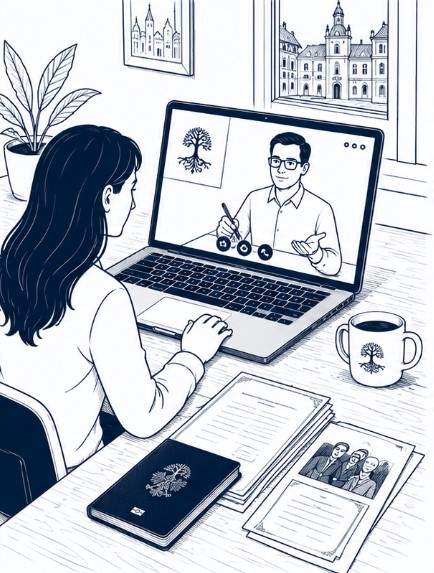
We guide you through obtaining certified birth certificates, naturalization records, census entries, and any supporting materials needed to prove your unbroken line of descent.
Prepare Your Application
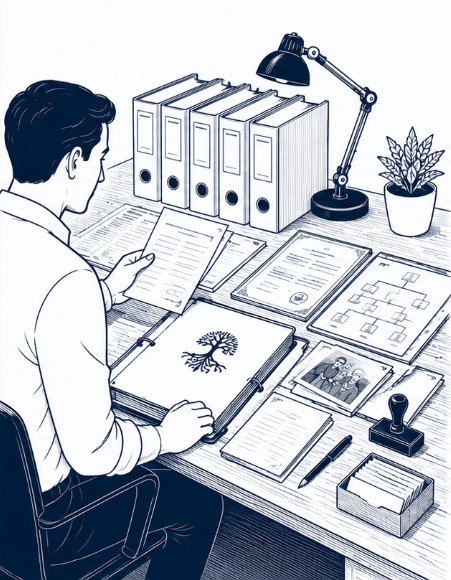
We complete the Citizenship Certificate application, organize every document, and draft explanatory notes for any name variations or gaps in the paper trail.
Submit & Track
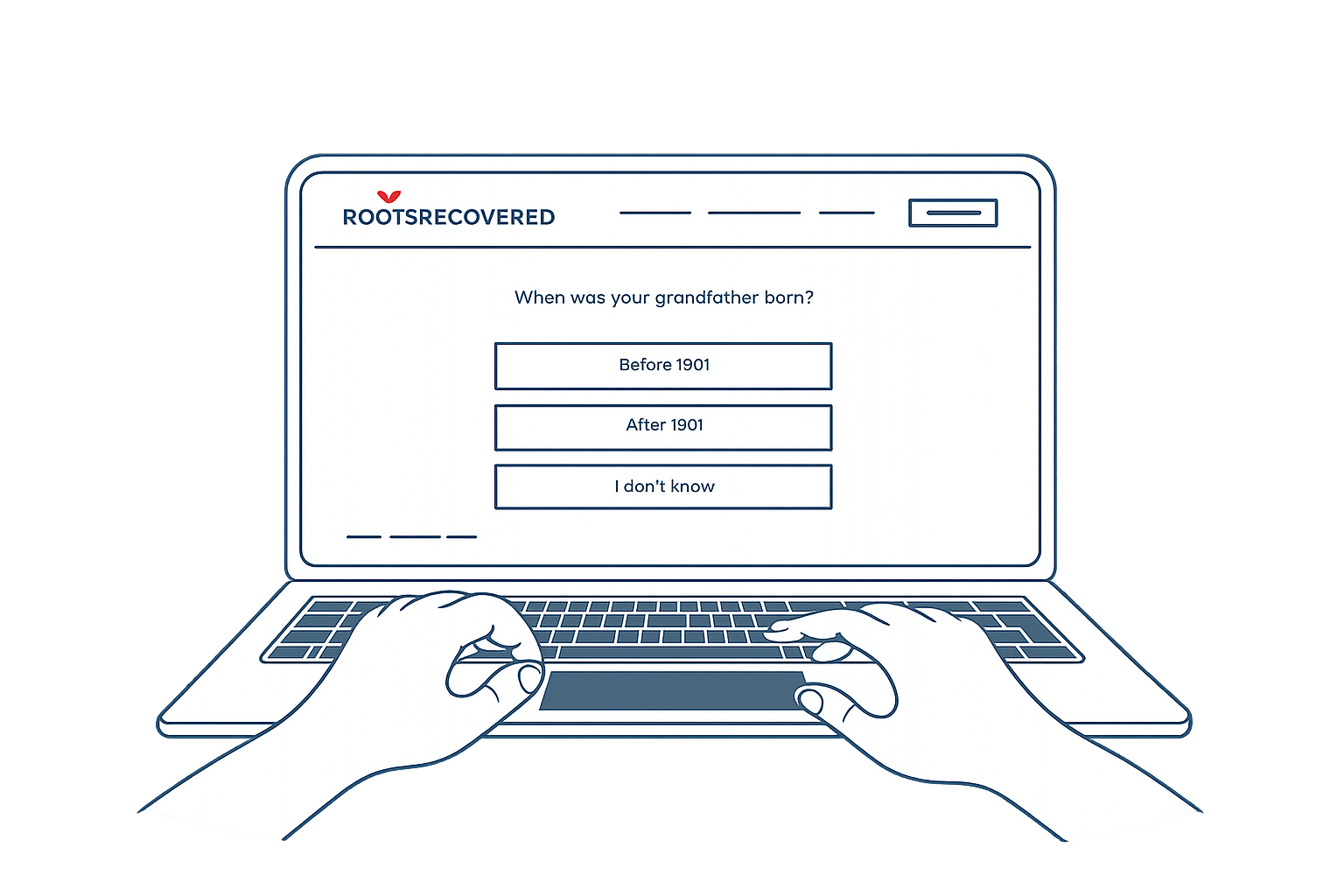
A Registered Canadian Immigration Consultant submits your application to Immigration, Refugees and Citizenship Canada (IRCC) and monitors progress until your Citizenship Certificate arrives.
What Canadian Citizenship Gives You
So much more than a passport. Canadian citizenship by descent can be a lifeline.

Live & Work in Canada
Full rights to live, work, and study anywhere in Canada — no work permit, no visa, no sponsor required.

Increased Global Mobility
Visa-free or visa-on-arrival access to over 185 countries, and one of the world’s most respected travel documents.
Pass It to Your Children
Your confirmed Canadian citizenship is hereditary. Your children — born anywhere — can inherit it from you.

Healthcare & Social Benefits
Access to Canada’s publicly funded healthcare system and social programs as a full citizen.
Dual Citizenship Allowed
Canada does not require you to renounce other citizenships. Keep every passport you hold.
Reconnect with Your Heritage
More than a legal status — it’s a reclaiming of identity, family history, and belonging.
Canadian Citizenship by Descent: Frequently Asked Questions
Canada’s citizenship law was amended in December 2025 to recognize generations of descendants who were previously cut off. If you have a Canadian-born ancestor, you may already be a Canadian citizen and not know it. This guide answers the questions our clients ask most often.
Eligibility
Who qualifies as a Canadian citizen by descent?
Under the current rules, IRCC is processing applications on the understanding that if you were born before December 15, 2025, you qualify as a citizen by descent if you can prove descent from any one of the following:
- A person born in what is now Canada.
- A British subject who was ordinarily resident in Canada on January 1, 1947 (or January 1, 1949, for Newfoundland and Labrador).
- A person who was naturalized as a Canadian.
- A person who has already received proof of Canadian citizenship from IRCC.
- A person who was a Canadian citizen on some other recognized basis.
Every ancestor in the chain between you and that qualifying person is also considered Canadian. There is no fixed generational cap. The only practical limit is your ability to document the chain of descent.
What changed for people born on or after December 15, 2025?
If you were born on or after December 15, 2025, you must additionally prove that your Canadian parent was physically present in Canada for at least 1,095 days at some point in their lifetime before your birth. The 1,095-day rule does not apply retroactively to anyone born before that date.
Do I need to wait for a parent or grandparent to apply first?
No. This is a common misconception! The application is for proof of citizenship you and your ancestors already hold under the law. You can apply directly even if your parents or grandparents never applied themselves.
My sibling, parent, or child has already received a Canadian citizenship certificate. Does that help my application?
Yes, often significantly. If a parent received their certificate before you were born and you were born before December 15, 2025, you may be able to reference your parent’s certificate number on your own application without retracing the full lineage. If a sibling, child, or other close relative has been approved, that approval is strong evidence that the shared ancestor was Canadian, which can streamline the review of your file.
My ancestor became a U.S. citizen before my parent was born. Does that disqualify me?
Not at all. Canadian citizenship can only be renounced through a very specific formal procedure. Naturalizing in another country, including the United States, does not extinguish Canadian citizenship under current law. If your ancestor naturalized in another country before the current law came into effect, you can also rest easy: the rules that did strip citizenship in such cases have been repealed retroactively, restoring citizenship to people who lost it that way.
Documents and Evidence
What does a successful application actually need to prove?
Two things, repeatedly, for every generation in the chain:
- That your qualifying ancestor was Canadian (typically by birth or naturalization in Canada).
- That each person between you and that ancestor is biologically or legally related to the next.
Name changes, particularly through marriage, must be accounted for. A marriage record is the standard way to bridge a maiden-to-married surname change, although a child’s birth certificate that lists the mother’s maiden name can sometimes do the same job.
What if I cannot find a birth record for my Canadian-born ancestor?
This is one of the most common situations we handle. Many Canadian provinces did not register births reliably until the late nineteenth or early twentieth century. IRCC accepts alternative evidence under the relevant scenario, including:
- Census records showing place of birth.
- Marriage records listing place of birth.
- Death records and obituaries.
- The birth records of the ancestor’s children, which often state the parent’s place of birth.
- Church and parish records.
These cases benefit from a clear cover letter that explains why the primary record is unavailable and identifies which alternative documents fill the gap. Building this kind of evidentiary package is one of the core services Roots Recovered, LLC provides.
My ancestor's name or date of birth appears differently on different documents. Is that a problem?
Usually not. First of all, IRCC follows the legal doctrine of idem sonans, which treats names that sound alike as the same name (McDonald and MacDonald, Jacques and Jack, and so on). But beyond that, there are actual people with common sense who will be looking at your applications. Compared with other citizenship by descent programs (here’s looking at you, Italy and Poland!), the Canadian process is one marked by an adherence to a holistic view of the application. Common nickname variations such as Robert and Bob, or Susan and Sue, are routinely accepted. Dropped or transposed middle names are also generally accepted. For records before the 1930s, age discrepancies are common and are usually overlooked when the rest of the evidence clearly identifies the same person. Where discrepancies are significant, a brief written explanation accompanying the documents helps the reviewer.
The Application Itself
Which forms does the application require?
Two main forms, plus supporting evidence:
- CIT 0001, the Application for a Citizenship Certificate.
- CIT 0014, the document checklist that identifies which scenario applies to you.
Most descent applications fall under Scenario 3 of CIT 0014, which covers people born outside Canada to a Canadian parent. Because citizenship by descent is treated as retroactive, every parent in your direct line is considered to have been Canadian, even if they never applied themselves.
Do I need photos? Where can I get them?
Yes. Citizenship certificate photos use the same dimensions as Canadian passport photos but require slightly different annotations on the back. Many U.S. studios that take passport photos can produce them once shown the Canadian specifications. Some Canadian consulates publish lists of approved providers in their region. We provide the exact specifications and back-of-photo wording to clients ahead of the appointment.
Should I choose a paper certificate or an e-certificate?
While we cannot guarantee government approval (as the final decision rests with consular authorities), we have a 98% success rate. Our full-service package includes a thorough review to ensure your application meets all requirements before submission.
Can my whole family apply together?
Yes. Multiple applicants in the same lineage can be submitted as a single packet, which is often more efficient because one set of supporting evidence can support everyone. Each applicant still needs their own forms, photos, and identity documents. There is one important caution: if any single applicant’s file is incomplete, IRCC will return the entire packet, delaying everyone by four to six weeks. Coordinating multi-generational family submissions is therefore one of the areas where having Roots Recovered, LLC manage the assembly genuinely matters.
Process & Services
What about my children and spouse?
Children born before December 15, 2025 are already Canadian if you are Canadian, and can be added to your packet or submitted later. Children born on or after December 15, 2025 are subject to the 1,095-day physical-presence rule for the Canadian parent.
A spouse does not automatically become Canadian by marriage. The route for a non-Canadian spouse is permanent residence through spousal sponsorship, followed by naturalization after a qualifying period of residence in Canada. We can refer spouses to specialists in that process when needed.
Processing and Timelines
How long will my application take?
Processing times vary considerably. As of early 2026, IRCC’s published average for proof-of-citizenship applications is approximately ten months, though some files move faster and others slower. The processing-time tool on IRCC’s website is the best live indicator.
Can I request urgent processing?
Yes, in defined circumstances such as imminent travel for medical reasons, employment, or to attend to a death in the family. IRCC does not always disclose its reasoning when granting or denying urgent processing. We help clients prepare urgent-processing requests with the supporting documentation that has historically been most persuasive.
How will I know IRCC received my application?
If the application passes the initial completeness review, IRCC issues an Acknowledgement of Receipt (AOR) by email or letter. The AOR contains a PR Number and a UCI Number, which are used to check application status going forward. If the application is returned as incomplete, the entire packet is mailed back, typically within four to six weeks, with notes identifying the deficiency.
How do I check the status of my application?
Once you have an AOR, IRCC’s online status checker uses your UCI and personal details to display the current stage of processing. Status updates are not always immediate, and the system sometimes shows “decision made” before the certificate itself is available.
How will IRCC contact me?
Almost always by email. We strongly recommend using a reliable email address (such as Gmail) on the application, monitoring it regularly, and checking the spam folder. Missed IRCC correspondence is one of the most common avoidable causes of delay.
Can I submit additional documents after I file?
Yes, but with caution. Once your application has been acknowledged, IRCC’s online portal allows clients to upload additional documents. Submitting unsolicited documents after the file is in queue can actually slow processing, however, because each addition restarts a portion of the review. The better practice is to wait for IRCC to request something specific and respond promptly to that request, usually by replying directly to the email it came from. Managing this kind of correspondence is part of what we do for clients during the wait.
After Approval
When does my Canadian citizenship begin?
It does not begin on the date of approval. The application asks Canada to confirm citizenship you already hold. If approved, your citizenship is recognized as having existed from your date of birth, or from the date Canadian citizenship became a legal status (January 1, 1947 in most of Canada, January 1, 1949 in Newfoundland and Labrador), whichever is later.
How do I download my e-certificate?
E-certificates are downloaded through the IRCC Portal. The process involves requesting an invite code, creating a portal account, signing in, and selecting the option to download the certificate. Any IRCC account can download a certificate so long as the requesting party has the necessary identifying information, which means one family member can retrieve certificates for the whole group.
How do I apply for a Canadian passport?
The citizenship certificate is the foundational document for a first-time Canadian passport application. Roots Recovered, LLC guides clients through the passport application as a follow-on step, including photo requirements, guarantor rules, and the choice between in-person and mail submission depending on residence.
What about other benefits, like Old Age Security or healthcare?
Canadian citizenship does not automatically grant access to provincial healthcare, which is generally tied to physical residence in a province and a waiting period after arrival. Federal benefits such as Old Age Security have their own residency-based eligibility rules. Citizenship is the foundation that makes future access possible; it is not, on its own, a substitute for residency.
Process & Services
What about my children and spouse?
Children born before December 15, 2025 are already Canadian if you are Canadian, and can be added to your packet or submitted later. Children born on or after December 15, 2025 are subject to the 1,095-day physical-presence rule for the Canadian parent.
A spouse does not automatically become Canadian by marriage. The route for a non-Canadian spouse is permanent residence through spousal sponsorship, followed by naturalization after a qualifying period of residence in Canada. We can refer spouses to specialists in that process when needed.
Looking Ahead
Is the law likely to change again?
It does not begin on the date of approval. The application asks Canada to confirm citizenship you already hold. If approved, your citizenship is recognized as having existed from your date of birth, or from the date Canadian citizenship became a legal status (January 1, 1947 in most of Canada, January 1, 1949 in Newfoundland and Labrador), whichever is later.
Why does the generational picture matter for my own descendants?
For people born after December 15, 2025, the burden of proving that each ancestor met the 1,095-day physical-presence requirement will compound with every passing generation. A grandchild applying ninety years from now, three generations removed from Canada, will face a much harder evidentiary task than someone applying today, unless each intervening generation establishes proof of citizenship during their own lifetime. Securing recognition now creates a documented record that future descendants can rely on rather than reconstruct.
How do I get started with Roots Recovered, LLC?
Reach out through rootsrecovered.com and we will schedule an initial consultation to review your family history, identify the qualifying ancestor, and outline the documentary evidence required for your specific lineage. From there we manage the records procurement, packet assembly, IRCC correspondence, and post-approval steps as a single coordinated process.
Roots Recovered, LLC specializes in citizenship by descent across Ireland, Germany, Poland, Austria, Slovakia, Lithuania, Luxembourg, Canada, and Portugal. Information in this FAQ reflects IRCC practice as of early 2026 and is not legal advice for any specific case.
Speak With a Citizenship Specialist
Our experienced team is here to help you navigate the citizenship-by-descent process. Fill out the form below to get started.