
Citizenship by descent, formally known as jus sanguinis (Latin for “right of blood”), is defined as the legal inheritance of citizenship through a bloodline connection to a citizen ancestor, regardless of where you were born. Checking ancestral citizenship qualification means confirming that an unbroken chain of citizenship transmission exists between you and that ancestor. Over 30 countries offer these programs as of mid-2026, with major legal reforms in Italy and Canada reshaping eligibility rules in 2025. This guide walks you through country requirements, documentation, and the exact steps to verify your eligibility.
What does checking ancestral citizenship qualification involve?
Ancestral citizenship eligibility rests on one core principle: citizenship must have passed continuously from your ancestor to you, generation by generation, without interruption. If any ancestor in your direct line naturalized as a citizen of another country before the next generation was born, the chain breaks. That single fact disqualifies more applicants than any other issue.
The legal standard varies by country, but the underlying logic is consistent. You must prove that your qualifying ancestor held citizenship at the moment your parent, grandparent, or you were born. Legal experts confirm that an ancestor’s naturalization status is often more decisive than their birthplace. This is a critical distinction that many applicants overlook.

Two terms define the boundaries of these programs. Jus sanguinis governs citizenship by descent. Jus soli (right of soil) governs citizenship by birthplace. Most citizenship-by-descent programs operate purely on jus sanguinis, meaning your birth location is irrelevant. What matters is your documented bloodline.
Which countries offer citizenship by descent, and how do rules differ?
The eligibility rules across ancestral citizenship programs vary significantly by country. Some nations allow claims through any generation, while others cap eligibility at parents or grandparents only.
| Country | Generational limit | Key requirement | Residency required? |
|---|---|---|---|
| Italy | Parent or grandparent (post-2025 reform) | Ancestor held Italian citizenship exclusively before descendant’s birth | No |
| Ireland | Parent or grandparent | Ancestor born in Ireland; grandparent route requires registration | No |
| Poland | Unlimited generations | Documented Polish ancestry and cultural connection | No |
| Canada | Unlimited (post-December 2025) | Substantial connection; 1,095 days physical presence for transmission | No |
| Hungary | Unlimited | Hungarian ancestry and basic language proficiency | No |
| United Kingdom | One generation only | Parent born in the UK | No |
Italy’s 2025 reform is the most significant recent change. Italy now restricts claims to applicants with a parent or grandparent born in Italy who held Italian citizenship exclusively, without naturalizing elsewhere, before the descendant’s birth. Claims through great-grandparents or further back are no longer accepted under the new rules for applications filed after march 27, 2025.
Canada moved in the opposite direction. Canada removed generational caps as of december 15, 2025, allowing any generation to inherit citizenship provided lineage is fully documented and a substantial connection to Canada is demonstrated for children born abroad after that date. This reform opens eligibility to many Canadians who were previously cut off after the second generation.
- Italy: Parent or grandparent only; ancestor must not have naturalized before your parent’s birth
- Ireland: Parent or grandparent; grandparent route requires Foreign Births Register entry
- Poland: No generational cap; Polish ancestry documentation required
- Canada: No generational cap (post-2025); substantial connection required for transmission
- Hungary: No generational cap; Hungarian language proficiency required
- United Kingdom: One generation; parent must have been born in the UK
Processing times across these programs typically run 2–5 years, and residency is generally not required during the application period. That said, language requirements, document authentication standards, and consulate procedures differ widely. Knowing the specific rules for your target country before you start saves significant time.
What documents do you need to prove ancestral citizenship eligibility?
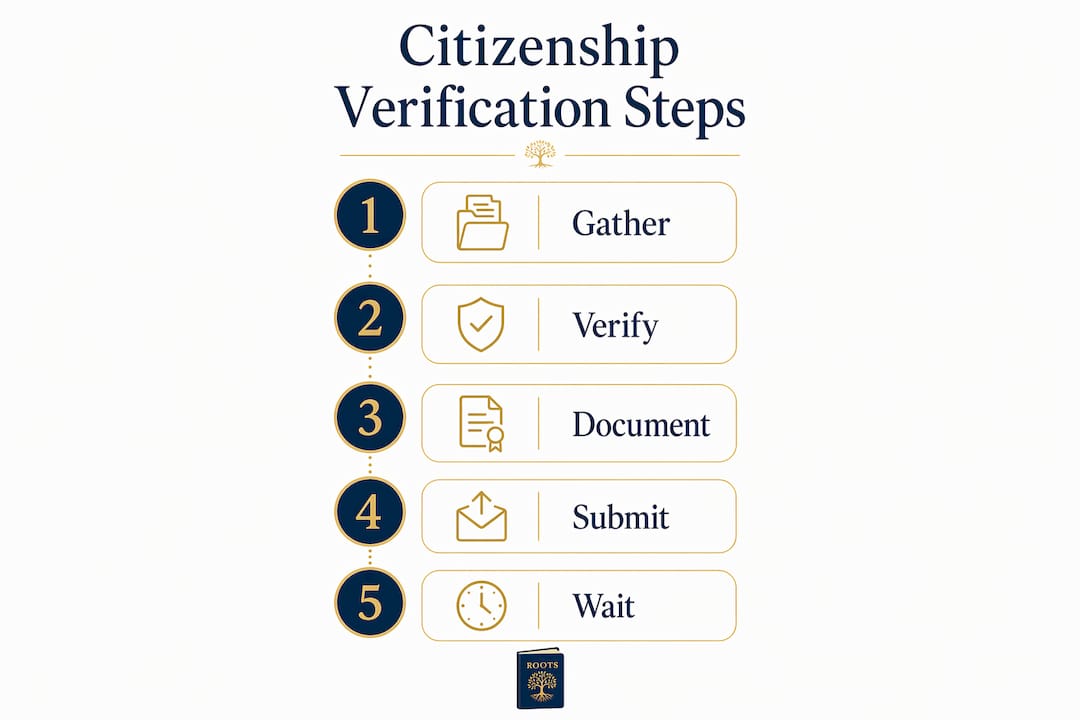
Documenting ancestry for citizenship requires a complete, unbroken chain of official records connecting you to your qualifying ancestor. Applicants must secure birth, marriage, and death certificates for every person in the direct lineage, plus naturalization records and certified translations where required.
A common mistake is assuming birth certificates alone are sufficient. Marriage and death records are equally critical because they prove lineage continuity and document name changes across generations. A woman who changed her surname at marriage, for example, requires both her birth certificate and marriage certificate to link her identity across records.
The core document checklist includes:
- Birth certificates for you, each parent, and each grandparent in the qualifying line
- Marriage certificates for every married ancestor in the chain
- Death certificates for deceased ancestors
- Naturalization records or a Certificate of Non-Naturalization for the qualifying ancestor
- Certified translations into the target country’s official language
- Apostilles on all foreign-issued documents, as required by the destination country
The Certificate of Non-Naturalization deserves special attention. This certificate is the definitive proof that your ancestor never naturalized as a citizen of another country, which confirms they retained their original citizenship. Without it, consulates often reject claims outright.
When vital records are missing due to destruction, war, or historical gaps, courts and consulates accept alternative evidence. Baptismal registers, ship manifests, census records, and court affidavits can substitute for missing official documents in many countries.
Pro Tip: Request your ancestor’s naturalization records from the U.S. Citizenship and Immigration Services (USCIS) genealogy program or the National Archives before anything else. These records reveal the exact naturalization date, which is the single most important fact in your eligibility analysis.
Step-by-step process to verify your citizenship lineage
Verifying your citizenship lineage follows a clear sequence. Skipping steps or working out of order creates gaps that consulates will flag during review.
-
Interview your oldest relatives. Family interviews uncover ancestor origins, approximate dates, and citizenship clues that no database contains. Ask about immigration dates, places of birth, and whether any ancestor became a citizen of another country.
-
Map your family tree with key dates. Record every birth, marriage, naturalization, and death date for each person in your direct line. Flag any gaps immediately. A clear visual map reveals where your documentation is strong and where it needs work.
-
Obtain official documents from vital record offices, national archives, and consulates. Contact the civil registry offices in your ancestor’s country of origin. For U.S.-based records, USCIS and the National Archives hold naturalization files going back to the 19th century.
-
Analyze naturalization dates relative to descendant births. This is the most critical analytical step. If your Italian great-grandfather naturalized as an American citizen in 1920 and your grandfather was born in 1922, the chain is broken for Italian claims. The dates must show that citizenship was still held at the moment of each descendant’s birth.
-
Match your lineage against the specific country’s eligibility criteria. Apply the generational limits, residency rules, and exclusivity requirements for your target country. Italy’s post-2025 rules, Canada’s substantial connection requirement, and Ireland’s Foreign Births Register each have distinct standards.
-
Consult a qualified citizenship attorney or professional genealogist if the chain is complex. Mixed lineages, missing records, and female-line transmission issues (discussed below) require expert analysis. A professional review before filing prevents costly rejections.
Pro Tip: Double-check naturalization dates against the birth dates of every descendant in the chain, not just the first generation. A naturalization that occurred between two generations, even decades apart, breaks the chain at that point.
Common challenges when checking your qualification
Missing documents are the most frequent obstacle in citizenship-by-descent claims. Records from 19th-century Europe were often destroyed by war, fire, or administrative neglect. When official records are unavailable, applicants can substitute baptismal registers, ship passenger manifests, census entries, or sworn affidavits from family members with direct knowledge.
Female-line transmission creates a separate category of complications, particularly for Italian claims. Italy did not recognize citizenship transmission through the maternal line before 1948. If your qualifying ancestor is a woman who transmitted citizenship before that year, the standard administrative route is closed. Legal workarounds exist, including court proceedings in Italy, but they add time and cost to the process.
Early naturalizations are another common trap. Many immigrants naturalized quickly after arriving in the United States in the early 20th century, sometimes within a year or two of arrival. If your ancestor naturalized before your parent or grandparent was born, the citizenship chain ends there. This is why obtaining the Certificate of Non-Naturalization is so critical before investing months in document collection.
Relying solely on oral family history without documentary support is the single most avoidable reason for claim denial. Consulates require paper evidence. A family story that an ancestor “never became American” carries no legal weight without a Certificate of Non-Naturalization or equivalent archival proof.
Realistic processing expectations also matter. Most citizenship-by-descent applications take 2–5 years from submission to approval. Consulate backlogs, document authentication delays, and country-specific review timelines all contribute. Starting with a complete, well-organized file reduces the risk of requests for additional information, which can add months to the process.
Roots Recovered, LLC: professional support for your eligibility assessment
Roots Recovered, LLC specializes in citizenship by descent eligibility assessments and application management for clients pursuing second passports through ancestral lineage. The firm maintains current expertise across the 2025 Italian reform, Canada’s December 2025 generational cap removal, and evolving requirements in Ireland, Poland, Hungary, and beyond. Roots Recovered, LLC handles document sourcing, certified translations, apostille coordination, and consulate liaison, so you are not navigating bureaucratic requirements alone. If you are ready to find out whether your family tree qualifies, a citizenship eligibility assessment with Roots Recovered, LLC is the clearest first step toward a confirmed answer.
Key Takeaways
Ancestral citizenship eligibility requires an unbroken, documented chain of citizenship transmission from a qualifying ancestor, verified against each country’s specific generational and exclusivity rules.
| Point | Details |
|---|---|
| Naturalization date is decisive | If your ancestor naturalized before the next generation’s birth, the citizenship chain breaks and the claim fails. |
| Country rules differ sharply | Italy limits claims to parents or grandparents post-2025; Canada now allows unlimited generations with a substantial connection. |
| Certificate of Non-Naturalization is critical | This document proves your ancestor retained citizenship and is often required before a consulate will accept a claim. |
| Alternative evidence is accepted | Baptismal registers, ship manifests, and census records substitute for missing vital records in most countries. |
| Professional review prevents rejections | Complex lineages, female-line issues, and missing records require expert analysis before filing. |
FAQ
What is citizenship by descent?
Citizenship by descent, or jus sanguinis, is the legal right to inherit citizenship through a bloodline connection to a citizen ancestor, regardless of your birthplace. Eligibility depends on an unbroken chain of citizenship transmission from that ancestor to you.
How many generations back can I claim ancestral citizenship?
The generational limit depends on the country. Italy now limits claims to a parent or grandparent under its 2025 reform, while Poland, Hungary, and Canada (post-December 2025) allow claims through any generation with proper documentation.
What is a Certificate of Non-Naturalization and why do I need it?
A Certificate of Non-Naturalization is an official document confirming that your ancestor never naturalized as a citizen of another country. It is the definitive proof that citizenship was retained and transmitted, and many consulates require it before processing a claim.
Can I claim citizenship through my grandmother’s maiden line?
Transmission through the female line is possible in most countries, but Italy restricts maternal-line claims made before 1948 through the standard administrative process. Legal proceedings in Italian courts offer a workaround, though they add time and cost.
How long does a citizenship-by-descent application take?
Most applications take 2–5 years from submission to approval, depending on the country, consulate workload, and completeness of your documentation file.