Slovenian citizenship by descent is granted for individuals who can demonstrate a clear ancestral connection to Slovenia.
If your parent was a Slovenian citizen, you’re already Slovenian by law, and you likely just need to register that fact with the local Slovenian consulate or embassy. This is known as automatic acquisition.
Alternatively, if you were born outside Slovenia to one Slovenian parent and another parent without citizenship or whose citizenship is unknown, you are also considered a Slovenian citizen at birth.
If you don’t meet the criteria for automatic acquisition but you have Slovenian roots, you may still be eligible for Slovenian citizenship via a grandparent, great-grandparent, or in some cases, great-great grandparent. In such cases, the process is more complicated. In order to successfully get your Slovenian dual citizenship recognized, you’ll need to:
- be over 18 and under 36 years old (there are ways to get Slovenian dual citizenship once you are over 36 but this is very much considered on a case-by-case basis);
- show that you have Slovenian ancestry, which can be done through various means such as providing long form, certified copies of birth, marriage, and other civil registry documents (all apostilled and translated);
- prove you haven’t been sentenced to prison for more than three months or have been on probation for more than a year as a result of criminal offenses;
- guarantee that you are not affiliated with a foreign intelligence service;
- provide a resume of your personal information;
- present proof of your current citizenship.
TL;DR:
- Registration must occur before age 36 for grandchildren and beyond, or else you will need to meet residence or naturalization requirements.
- Proof of descent relies heavily on long form birth, marriage, and other civil registry documents, all of which require apostilles and certified translations.
- Naturalization paths for descendants beyond the second generation often demand documented ties to Slovenia, such as community involvement or residence.
- Timelines vary: registration can take several months, while naturalization procedures are longer and depend on residence or discretionary approval.
- Hiring a consultant is advisable for complex cases, especially beyond the second generation, to avoid common document mistakes and streamline the process.
Table of Contents
- How Slovenian Citizenship by Descent Works
- Does Your Lineage Qualify? Rules by Generation
- What Documents Do You Need to Prove Descent?
- Which Application Pathway Fits Your Situation?
- How Do You Prove Active Ties or National Interest?
- How Long Does It Take and Where Do You File?
- Your Action Plan: Six Steps and the Mistakes to Avoid
- How Roots Recovered, LLC Simplifies the Process
- Where to Verify These Rules Yourself
- Sources
How Slovenian Citizenship by Descent Works
Slovenian nationality law runs on jus sanguinis, meaning citizenship passes through blood, not birthplace. If you were born to at least one Slovenian citizen parent, you acquired citizenship automatically at birth, no matter where you were born or whether anyone ever filed paperwork for you, according to the U.S. Embassy in Slovenia.
Beyond that first generation, the law splits into three distinct tracks:
- Registration in the civil registry, which confirms citizenship you already legally hold, often subject to an age cutoff.
- Facilitated naturalization, built for emigrants and their descendants who can meet a residence requirement.
- Extraordinary naturalization, a discretionary path for people who can demonstrate genuine ties to Slovenia even without residence.
Slovenia generally permits dual citizenship for people acquiring it through descent, but voluntary naturalization elsewhere can sometimes trigger renunciation questions depending on when and how it happened.
Does Your Lineage Qualify? Rules by Generation
Your generational distance from the Slovenian citizen in your family tree determines which “track” applies. As expected, the rules tighten with each step back.
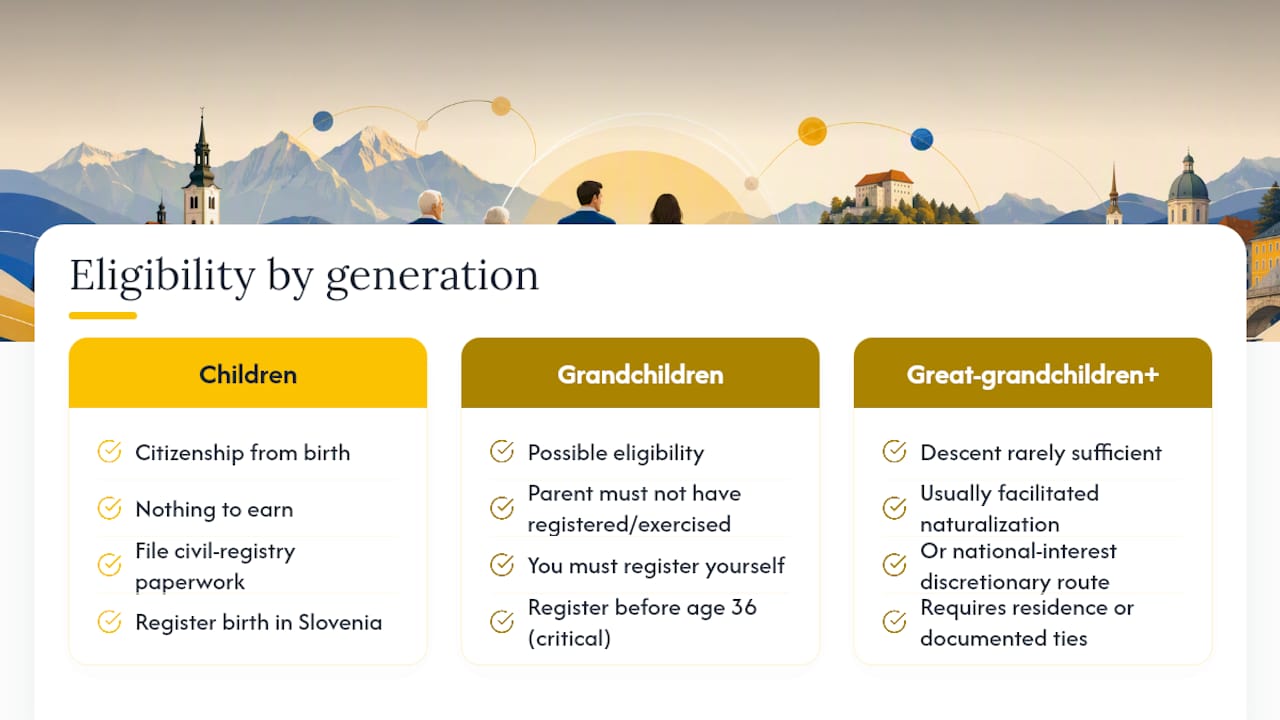
Children of a Slovenian citizen are Slovenian from birth. There’s nothing to “earn,” only paperwork to file, usually a request to register the birth in Slovenia’s civil registry so the citizenship becomes officially recognized and documented.
Grandchildren occupy a gray zone. If your parent never registered or exercised their own Slovenian citizenship, you may still qualify, but you’ll typically need to register it yourself, and doing so before you turn 36 makes the process easier than if you register after.
Great-grandchildren and beyond rarely qualify through descent alone. At that distance, the law shifts toward facilitated naturalization/discretionary national interest route, which usually requires actual residence or documented ties, according to the consolidated Citizenship Act.
As expected, the “before age 36” rule is the most consequential detail in this entire process. Miss that window for registration, and you’re pushed into a naturalization track with residence or evidentiary demands that a timely registration would have avoided entirely.
What Documents Do You Need to Prove Descent?
Your entire application rises or falls on paper trails, and Slovenian authorities are unforgiving about format.
- Long-form birth certificates for yourself, your parent, and (if relevant) your grandparent, showing full names, dates, and places of birth.
- Marriage certificates connecting generations, especially where a name changed.
- Civil registry extracts from Slovenia, if an ancestor’s birth or citizenship was ever recorded there.
- Secondary evidence when primary records are missing or damaged: church baptismal records, old passports, naturalization certificates from the country your ancestor immigrated to, or immigration ship manifests.
Every document not already in Slovenian needs a certified translation, and most need an apostille, the international authentication stamp that confirms a document is genuine for use abroad. In the United States, apostilles come from the Secretary of State’s office in the state where the document was issued; federal documents get authenticated through the U.S. Department of State. Certified translations must typically come from a translator recognized for legal work, not a casual bilingual friend.
Pro Tip: Order your documents in the order your family tree runs backward, not the order you happen to find them. Missing a single certified link in the chain, say a great-grandmother’s maiden name mismatch, can stall an otherwise strong application for months.
If you’re assembling a file for a formal consultation, this legal consultation preparation guide walks through how to organize documentation before you ever sit down with an attorney or consultant, which saves real time on both sides.
Which Application Pathway Fits Your Situation?
Once you know your generation, the pathway usually becomes obvious.
- Registration as a citizen by descent works for children and many grandchildren, filed most often through a Slovenian consulate. Age 36 is the hard cutoff for straightforward registration in many cases, so don’t sit on this one.
- Facilitated naturalization targets emigrants and their descendants up to the fourth generation, but it typically demands at least one year of actual, continuous residence in Slovenia before you apply, per Gov.
- Extraordinary naturalisation exists for cases where residence isn’t practical, but national interest or documented cultural ties are. Article 12 of the Citizenship Act gives the ministry discretion here, and the Government Office for Slovenes Abroad often supplies the opinion that shapes the ministry’s decision.
Registration is generally filed at a Slovenian consulate; naturalization applications usually route through the Ministry of the Interior, sometimes requiring an in-person appearance in Slovenia itself.
How Do You Prove Active Ties or National Interest?
When descent alone doesn’t clear the bar, especially past the second generation, you need to show Slovenia is more than a line on your family tree.
Strong evidence tends to include:
- Signed letters from Slovenian cultural or fraternal organizations describing your specific, dated involvement.
- Membership records or dues receipts spanning multiple years, not a single event.
- Transcripts from Slovene language courses or documented participation in heritage programs.
- Lease agreements, residency registration, or tax records if you’ve actually lived in Slovenia.
Practitioners who handle these cases note that applicants beyond the second generation succeed more often when they lean on sustained residence or years of documented community involvement rather than descent alone, a pattern reflected in practical guidance from immigration specialists. The weakness that sinks most files isn’t lack of heritage. It’s a single undated letter claiming years of involvement with nothing to back the timeline.
Pro Tip: Ask any organization writing you a support letter to include specific dates and roles, not just “has been an active member.” Vague testimonials rarely survive scrutiny.
How Long Does It Take and Where Do You File?
Timelines vary widely depending on which path you’re on and how complete your file is.
- Registration tends to move fastest, often resolved within several months when documents are complete and the age-36 window hasn’t closed.
- Facilitated naturalization stretches longer because of the one-year residence requirement itself, plus processing time after you apply.
- Extraordinary naturalisation is the least predictable, since ministry discretion and the advisory opinion from the Government Office for Slovenes Abroad both factor in.
Budget for several fee categories: consular processing fees, certified translation costs (often priced per page), apostille fees charged by your state, and any professional assistance you hire. File registration and most facilitated naturalization paperwork through a Slovenian consulate; extraordinary naturalisation frequently requires direct contact with the Ministry of the Interior and, at some stage, physical presence in Slovenia. Build in a buffer of several extra months past whatever timeline you’re quoted.
Your Action Plan: Six Steps and the Mistakes to Avoid
- Identify your qualifying ancestor and confirm their citizenship status, not just their birthplace.
- Order primary documents first: birth and marriage certificates for every generation in the chain.
- Authenticate and translate everything through an apostille and a certified Slovenian translator.
- Compile active-ties evidence if you’re past the second generation.
- Choose your filing route based on generation, age, and residence feasibility.
- Submit through the correct consulate or ministry office, and keep copies of everything.
The mistakes that sink applications repeat themselves: short-form birth certificates instead of long-form, apostilles obtained from the wrong state office, and active-ties letters with no dates. Before filing anything, ask a consulate or consultant directly what document format they require and whether your specific generation needs residence proof.
Pro Tip: Hiring a consultant pays off most when your lineage crosses into grandparent or great-grandparent territory, where the paperwork gets genuinely complicated. For a straightforward parent-to-child case, you may not need one at all.
If you’re still mapping out which category you fall into, this overview of citizenship by descent breaks down how ancestral citizenship claims work across different countries.
How Roots Recovered, LLC Simplifies the Process
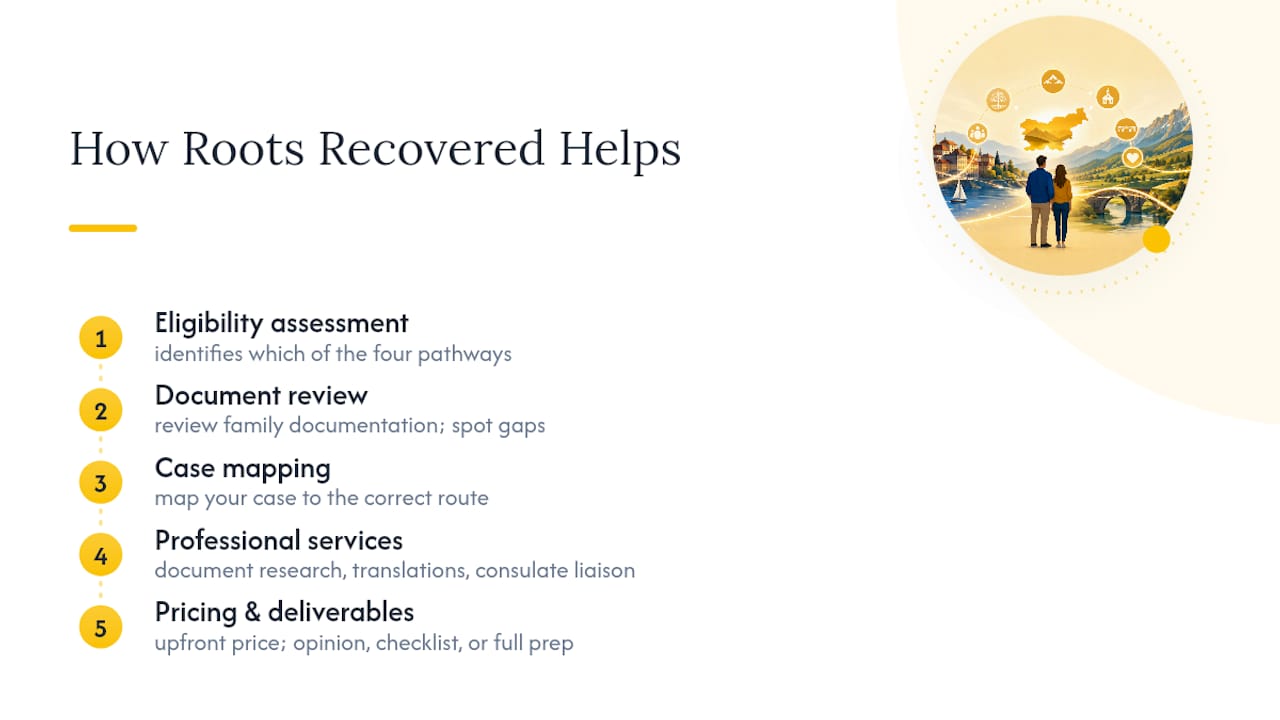
An eligibility assessment can tell you upfront exactly which of the four pathways your lineage supports, before you spend money on documents you might not need.
A typical engagement starts with reviewing your family’s documentation, identifying gaps, and mapping your specific case against the registration, facilitated naturalization, or extraordinary naturalisation criteria. From there, professional services may include document research, coordination of certified translations, and liaising with the relevant consulate, with pricing agreed upfront rather than billed by the hour. When comparing consultants, ask what deliverables you actually receive: a written eligibility opinion, a document checklist, or full application preparation are very different levels of service.
If your family history points to Slovenia and you’re ready to find out which route applies to you, start with a citizenship eligibility assessment to get a clear answer instead of a guess.
Where to Verify These Rules Yourself
- Gov: official government guidance on pathways and requirements.
- Gov: the authority handling naturalization decisions.
- Citizenship Act (Consolidated): the legislation itself.
- U.S. Embassy in Slovenia: practical guidance for U.S.-based applicants.