
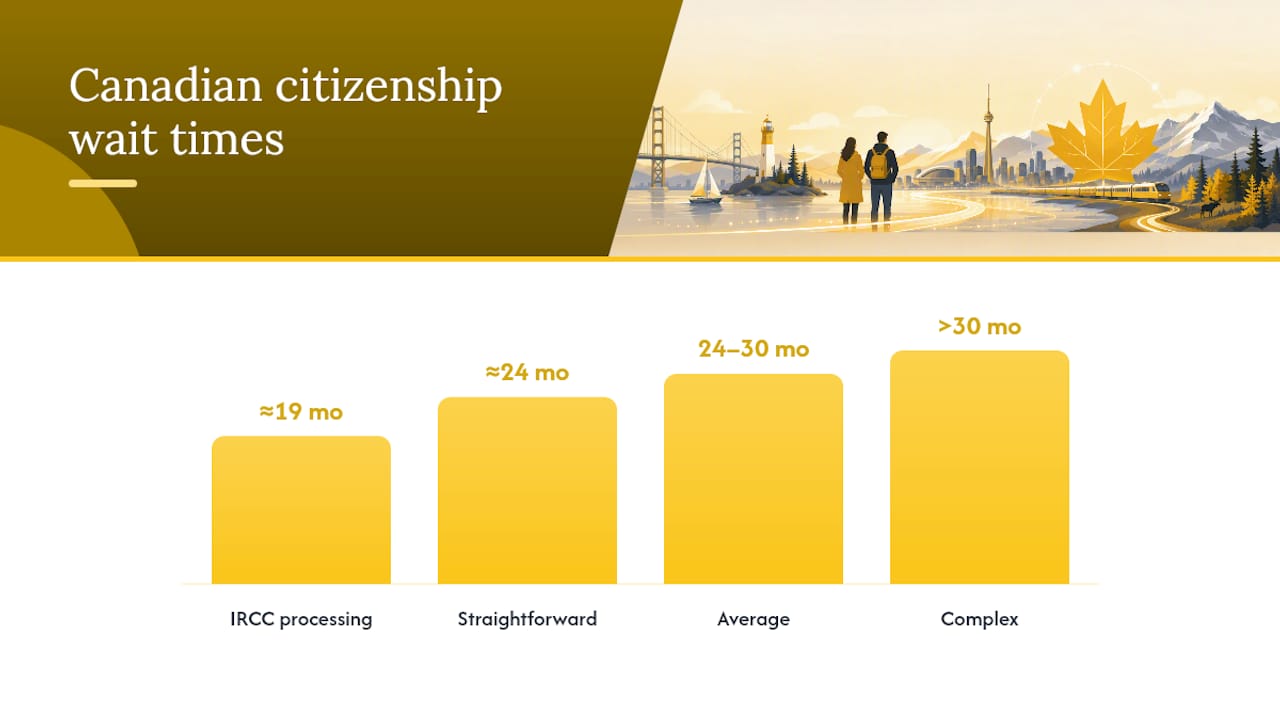
If you have a Canadian parent or grandparent, your realistic wait for a proof of Canadian citizenship certificate from Immigration, Refugees and Citizenship Canada (IRCC) is currently about 19 months from the date IRCC receives a complete application. The queue was nearly 100,000 files as of mid-2026, and IRCC’s forward-looking estimate means that waiting longer to apply almost always means a longer wait. The single most important action you can take right now is to start gathering original-source documents and submit a complete application as soon as possible.
Quick verdict by case complexity:
- Straightforward (parent born in Canada, complete records on hand): around two years total, including document prep
- Average (multi-generation foreign births, records available but need ordering): around two to two and a half years total
- Complex (missing records, name changes, alternative evidence needed): over two and a half years, sometimes significantly longer
Hiring a consultant before you submit reduces the risk of a completeness return, which would remove your file from the queue entirely and restart your wait.
Key Takeaways
The Canadian citizenship by descent timeline is currently driven by a near-100,000-file queue, making early submission with a complete, original-source document package the single most important factor in your overall wait.
| Point | Details |
|---|---|
| Current processing time | IRCC’s estimate is about 19 months from receipt of a complete application as of July 2026. |
| Original-source documents required | IRCC now requires records from issuing authorities; genealogy-site printouts are not accepted as primary evidence. |
| Completeness check is critical | A returned application restarts your queue position, adding 19+ months to your total wait. |
| Bill C‑3 expanded eligibility | Many people born abroad before December 15, 2025 are automatically Canadian and need a certificate to prove it. |
| Roots Recovered, LLC | Provides eligibility assessment, original-source record ordering, and pre-submission review to reduce requeue risk. |
Table of Contents
- What does the Canadian citizenship by descent timeline look like, stage by stage?
- Which documents do you need, and what causes the most delays?
- How does hiring a consultant actually change your timeline?
- Three sample timelines: where does your situation fit?
- What will this cost you? A realistic budget breakdown
- What should you do after you receive the citizenship certificate?
- Roots Recovered, LLC handles the document work so you don’t lose your queue position
- Useful sources to monitor for current processing times and rules
What does the Canadian citizenship by descent timeline look like, stage by stage?
Citizenship by descent operates under the principle of jus sanguinis, meaning citizenship passes through bloodline rather than place of birth. Since Bill C‑3 took effect on December 15, 2025, the first-generation limit has been removed, and many people born abroad are now automatically Canadian citizens who simply need a certificate to prove it.
Here is how the process unfolds, with realistic time ranges at each stage:
| Stage | Typical Duration | Key Trigger |
|---|---|---|
| Eligibility assessment | 1–4 weeks | Confirm qualifying ancestor and generation |
| Document retrieval | 4–12 weeks | Order from original-source authorities |
| Application preparation | 2–4 weeks | Completeness review before submission |
| IRCC Acknowledgement of Receipt (AOR) | about 2 weeks after submission | IRCC confirms receipt and begins completeness check |
| Processing / officer review | over a year | File enters queue after completeness check passes |
| Requests for more information (if any) | Adds 2–3 months | IRCC contacts applicant; clock pauses |
| Decision and certificate issuance | 2–4 weeks after decision | Certificate mailed or available for pickup |
The completeness check is the stage most applicants underestimate. IRCC runs this check before placing your file in the processing queue, and a returned application goes to the back of the line. For U.S.-based applicants, add a few extra days for international mail or courier delivery when submitting a paper application via form CIT 0001. Most applicants now use IRCC’s secure online portal, which starts the clock the moment IRCC receives a complete submission.
Pro Tip: Before you submit, run your own completeness check against IRCC’s current checklist. A single missing color copy or an unsigned form is enough to trigger a return and reset your place in the queue.
Which documents do you need, and what causes the most delays?
IRCC’s updated guidance now requires that every document proving your line of descent come from the original source authority, such as a vital statistics office, civil registry, or national archive. Printouts from genealogy subscription sites like Ancestry or FamilySearch are treated as research aids only, not primary evidence.
Core document checklist:
- Your government-issued photo ID and your own birth certificate (original or certified copy from the issuing authority)
- Birth certificate for each intervening generation between you and your Canadian ancestor
- Marriage and death records for each generation where names changed or a parent is deceased
- Proof of your Canadian ancestor’s citizenship: a Canadian birth certificate, Certificate of Canadian Citizenship, Canadian passport, or naturalization records
- Clear, legible color copies of all documents
- Certified translations for any document not in English or French
When an official record simply does not exist, IRCC does not automatically reject your application. You must submit a written explanation and evidence that you genuinely searched for the record, such as a no-record letter from the issuing authority or documented correspondence showing your search efforts.
The most common delay triggers:
- Secondary-source printouts submitted in place of original records
- Poor-quality or black-and-white copies
- Missing marriage certificates that explain a name change between generations
- Late civil registrations or records from countries with incomplete archives
- No-record letters missing from files where records are unavailable
For children born on or after December 15, 2025, where the relevant parent was also born outside Canada, a 1,095-day physical presence requirement applies. Those born before that date are grandfathered and thus exempt from this test.
Pro Tip: Order vital records directly from the issuing state or provincial vital statistics office, not from a third-party reseller. The issuing authority’s certified copy is the only version IRCC will accept as primary evidence.
How does hiring a consultant actually change your timeline?
A consultant’s most valuable contribution is not speed for its own sake. It is the prevention of the completeness return that would cost you 19+ months of requeue time. Here is where professional help makes a concrete difference:
- Preliminary eligibility audit. A consultant maps your family tree against current IRCC rules, including the Bill C‑3 changes, before you spend money on document retrieval. This prevents wasted effort on ineligible lines.
- Targeted record ordering. Consultants with established channels order directly from original-source authorities, reducing retrieval time and avoiding the common mistake of accepting secondary copies.
- Pre-submission completeness review. Every document is checked against IRCC’s current checklist before the application goes in. This is the step that most directly protects your queue position.
- Dossier organization and submission support. A well-organized, clearly labeled application reduces the likelihood of an officer requesting clarification.
- Response to IRCC information requests. If IRCC contacts you mid-process, a consultant can prepare a targeted, complete response quickly, minimizing the pause in processing.
When hiring a consultant is especially worth it:
- Your family tree spans more than two generations of foreign births
- Civil records are missing, damaged, or held in a foreign archive
- You need a Canadian passport within 18–24 months for travel or residency purposes
- You have previously received a surrender letter or a review notice from IRCC
- Name changes across generations are undocumented
When evaluating a consulting firm, look for transparent pricing, a documented success rate, a written scope of work, and a clear explanation of what happens if IRCC requests additional information after submission.
Three sample timelines: where does your situation fit?
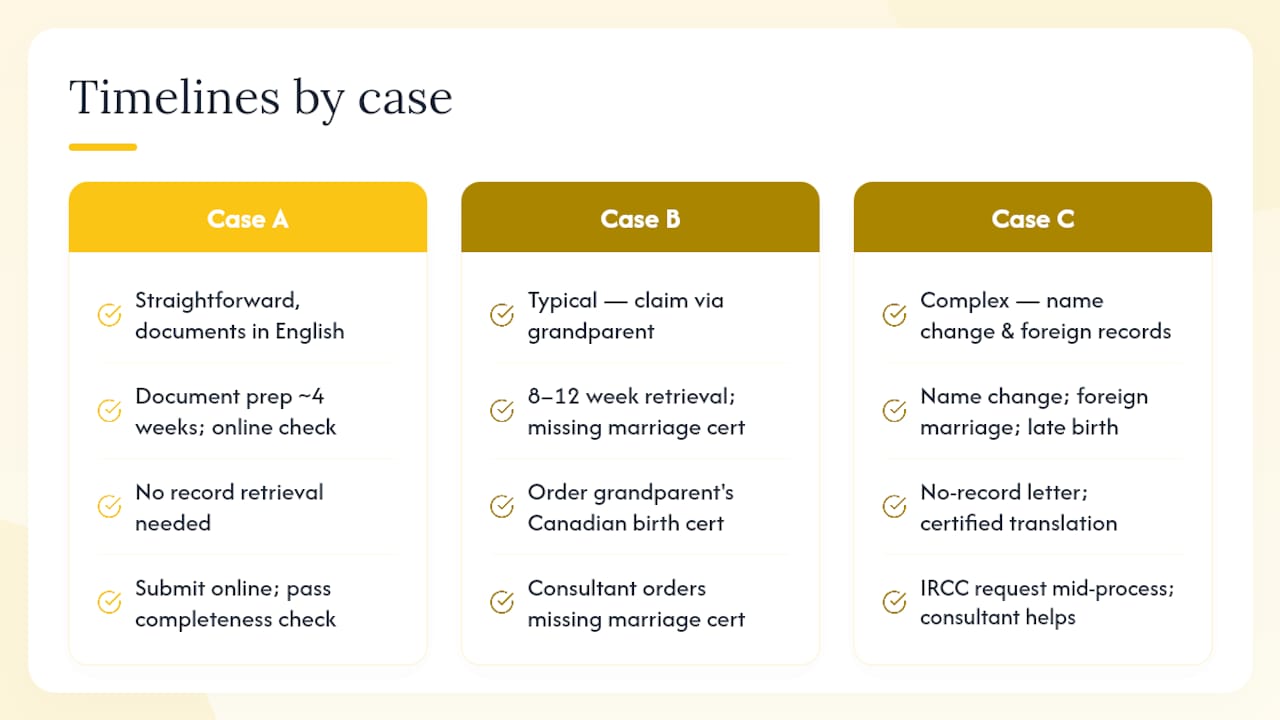
Case A — Straightforward. Your parent was born in Canada, you have their Canadian birth certificate, your own birth certificate, and both documents are in English. Document prep takes about four weeks. You submit online, pass the completeness check, and wait in the queue. Total realistic timeline: 20–24 months.
Case B — Typical. You are claiming through a grandparent born in Canada. Your parent was born in the United States. You need to order your grandparent’s Canadian birth certificate from a provincial vital statistics office and gather your parent’s U.S. birth certificate. Record retrieval takes 8–12 weeks. A consultant catches a missing marriage certificate during the pre-submission review and orders it before submission. Total realistic timeline: 26–30 months.
Case C — Complex. Your Canadian ancestor was born in Canada but emigrated decades ago. Records include a name change, a marriage certificate held in a foreign civil registry, and a birth registration that was filed late. You need a no-record letter from one jurisdiction and a certified translation from another. IRCC issues a request for more information mid-process. A consultant manages the foreign record retrieval and prepares the IRCC response. Total realistic timeline: 32–40 months, possibly longer without professional help.
What will this cost you? A realistic budget breakdown
| Cost Category | Typical Range (USD unless noted) | Notes |
|---|---|---|
| IRCC application fee (adult) | $75 CAD | Fixed government fee; set by IRCC |
| Vital records (per document) | about $20–$75 USD | Varies by issuing jurisdiction |
| Certified translations | $50–$100 per document | Required for non-English/French records |
| Notarizations and courier fees | $30–$100 | Varies by document count and destination |
| Consultant fee | Varies by scope | Project-based or hourly; request written scope |
The $75 CAD government fee is fixed. Everything else scales with the complexity of your family tree. A straightforward single-generation case may cost a few hundred dollars in third-party fees. A multi-generation case with foreign records and translations can run considerably higher.
Budgeting advice:
- Set aside a contingency for additional record searches IRCC may request after submission
What should you do after you receive the citizenship certificate?
Receiving your Certificate of Canadian Citizenship is the finish line for the application, but it opens several immediate next steps.
- Register with the nearest Canadian consulate — U.S.-based Canadians are encouraged to register with Global Affairs Canada’s Registration of Canadians Abroad service. This keeps you connected to consular support and emergency notifications.
For a detailed walkthrough of what to expect at a consular appointment, including what documents to bring and how the process works for U.S.-based applicants, review IRCC’s consular guidance before scheduling.
Roots Recovered, LLC handles the document work so you don’t lose your queue position
The biggest risk in a 19-month queue is not the wait itself. It is submitting an incomplete application and going back to the start. Roots Recovered, LLC specializes in exactly the work that prevents that outcome: a thorough eligibility assessment, direct ordering from original-source authorities, and a pre-submission completeness review against IRCC’s current checklist. Clients receive a written scope of work, transparent pricing, and support through any IRCC information requests that arise after submission.
If your family tree spans multiple generations, involves foreign civil records, or includes name changes that need documentation, the cost of professional preparation is small compared to the cost of a requeue. To see how Roots Recovered, LLC approaches Canadian citizenship by descent cases, or to request an eligibility assessment, visit the firm’s Canada services page and start with a consultation.
Useful sources to monitor for current processing times and rules
Processing times, fees, and documentary requirements change as IRCC updates its guidance. Before you plan travel, book consular appointments, or set passport-dependent deadlines, verify the current figures directly from official sources.
- Canada’s processing time for proof of citizenship jumps to 19 months as the queue nears 100,000 | CIC News
- Proof Of Canadian Citizenship Processing Time 2026 (19‑Month Wait And 100,000‑File Queue Explained)
- Canada just changed what counts as proof of citizenship by descent — here’s the breakdown | CIC News
- Canada citizenship by descent: who qualifies after Bill C-3 · IRCC.com
This article is general information, not legal advice. Fees, processing times, and eligibility rules change. Confirm current requirements with IRCC directly or with a qualified citizenship consultant before submitting your application.