
Yes, if you’re a U.S. citizen with dual nationality, you generally must file a U.S. federal tax return on your worldwide income once you cross the standard filing threshold, no matter where you live or which second passport you hold. The Foreign Earned Income Exclusion and Foreign Tax Credit usually prevent you from paying income tax twice on the same dollar. But reporting duties like the FBAR and FATCA’s Form 8938 stand apart from your tax bill entirely, and they carry their own penalties even when you owe the IRS nothing.
TL;DR:
Dual citizens working in high-tax countries usually benefit more from the Foreign Tax Credit, while those in low-tax jurisdictions often gain more from the Foreign Earned Income Exclusion.
Foreign bank account balances exceeding $10,000 across all accounts require filing the FBAR, regardless of whether income tax is owed, with penalties for non-compliance.
The filing deadline for U.S. citizens abroad is June 15, but any tax owed is still due by April 15, accruing interest from the original date.
Dual-status years, caused by moving to or from the U.S., complicate filings and limit deductions, increasing the risk of errors without proper knowledge.
Proper reporting on foreign investments, especially PFICs, is critical, as failing to file Form 8621 can trigger harsh tax penalties.
Table of Contents
-
Renouncing U.S. Citizenship: The Exit Tax and What Triggers It
-
When Tax Complexity Meets Citizenship Questions: Getting the Right Help
Dual Citizenship Taxes USA: The Quick-Reference Checklist
Before diving into the mechanics, here’s what you need to know at a glance. These are the numbers and dates that determine whether you’re compliant or quietly accumulating risk.
-
Filing trigger: Gross income above the standard threshold for your filing status means you file Form 1040, wherever you live.
-
FEIE cap: Form 2555 lets you exclude a set amount of foreign earned income per year, but only if you pass the bona fide residence or physical presence test.
-
FTC alternative: Form 1116 credits foreign income taxes you’ve already paid, dollar for dollar, against your U.S. tax bill.
-
FBAR threshold: File FinCEN Form 114 if your combined foreign account balances topped $10,000 at any point in the year, through the BSA E-Filing System.
-
FATCA threshold: Form 8938 kicks in at higher, residency-dependent thresholds for specified foreign financial assets, filed with your 1040.
-
Deadline: Automatic extension to June 15 if you live abroad, with tax payment still due by the regular April date.
Pro Tip: Mark your calendar for April, not June. The extension moves your paperwork deadline, not your payment deadline, and interest starts accruing from the original due date whether you’ve filed yet or not.
The $10,000 FBAR threshold trips up more dual citizens than any other rule on this list, largely because it’s an aggregate figure across every foreign account you control, not a per-account minimum.
Do I Have to File U.S. Taxes as a Dual Citizen?
The United States taxes based on citizenship, not residence. That single fact separates it from almost every other country your second passport might come from, and it means holding a foreign passport, voting in foreign elections, or paying foreign income tax never cancels your U.S. filing duty on its own.
You report worldwide income on Form 1040 the same way a citizen living in Ohio would, whether your paycheck comes from Toronto, Dublin, or Rome. The filing thresholds follow your status:
-
Single filers: generally required to file above the standard IRS filing threshold in gross income
-
Married filing jointly: a higher combined threshold applies
-
Self-employed individuals: file if net earnings exceed $400, a much lower bar that catches many freelancers and consultants abroad off guard
A dual citizen working as a freelance translator in Lisbon who nets $3,000 a year still has to file, even though that same income would fall below the threshold for an employee.
Citizens living outside the United States get an automatic two-month extension, pushing the filing deadline from April 15 to June 15, according to IRS guidance for citizens abroad. You can request a further extension to October 15 using Form 4868. What trips people up is assuming this pushes back payment too. It doesn’t. Any tax owed is still due by the regular April date, and interest accrues on the unpaid balance from that date forward regardless of which extension you’re using.
If you moved to or from the United States mid-year, you may fall under dual-status rules covered in IRS Publication 519, which we’ll unpack in more detail later. For now, know that arrival and departure years often require different treatment than a full calendar year of citizenship abroad.
How to Avoid Double Taxation: FEIE vs. Foreign Tax Credit
Nobody wants to pay income tax to two governments on the same paycheck. The IRS gives you two main tools to prevent that, and choosing the wrong one, or failing to choose at all, is where a lot of dual citizens overpay.
1. The Foreign Earned Income Exclusion (Form 2555)
FEIE lets you exclude a capped amount of foreign earned income from U.S. taxation each year. To qualify, you need to pass one of two tests described in IRS Publication 54: the bona fide residence test (you’ve established a genuine home in a foreign country for an uninterrupted period covering a full tax year) or the physical presence test (you’re physically outside the U.S. for at least 330 full days during any 12-month period). FEIE only applies to earned income, meaning wages and self-employment earnings. It does nothing for dividends, rental income, capital gains, or pensions.
2. The Foreign Tax Credit (Form 1116)
FTC credits foreign income taxes you’ve already paid against your U.S. tax liability, dollar for dollar up to certain limits. Unused credits carry back one year or forward up to ten, per IRS treaty and credit guidance. This is the tool that matters for passive income, since FEIE can’t touch it, and it’s often the stronger choice for anyone in a high-tax country.
3. The practical decision rule
Here’s the shortcut most tax professionals use: if you live in a country with tax rates higher than the U.S. (much of Western Europe, for example), the Foreign Tax Credit usually wins, because your foreign tax bill likely exceeds what you’d owe the IRS anyway, wiping out your U.S. liability with credit to spare. If you live in a low-tax or no-tax jurisdiction (the UAE, for instance, or certain Caribbean nations), FEIE tends to be more valuable, since there’s little or no foreign tax to credit against, and excluding the income outright saves you more.
This lines up with what Publication 54 suggests: dual citizens in high-tax countries generally do better with the credit, while FEIE serves earned income best in lower-tax jurisdictions.
Consider two contrasting scenarios. A dual citizen employed in Germany, where income tax rates commonly exceed U.S. rates, will typically find the Foreign Tax Credit erases their U.S. liability entirely, with credits left over to carry forward. A dual citizen running a small consulting business from a low-tax Gulf state, by contrast, usually benefits more from excluding earned income outright under FEIE, since there’s minimal foreign tax to offset against a credit.
Pro Tip: Run both calculations before you file, not after. FEIE and FTC interact with retirement contributions, the Child Tax Credit, and other provisions differently, and once you elect FEIE, revoking it later triggers a five-year waiting period before you can re-elect it.
The pitfalls cluster around two misunderstandings. First, FEIE excludes earned income only, so self-employment tax (Social Security and Medicare) still applies even after you’ve excluded the income for regular tax purposes. Second, FTC requires you to categorize income correctly (passive versus general category, for instance) because credits can’t freely cross those baskets.
Reporting Rules: FBAR, FATCA, PFICs, and Other Disclosures
Income tax is only half the compliance picture. The other half is disclosure, and this is where dual citizens who owe zero U.S. tax still end up facing five and six-figure penalty exposure.
FBAR (FinCEN Form 114). If the combined balance of your foreign bank, brokerage, or pension accounts exceeded $10,000 at any single moment during the year, you file the FBAR through the BSA E-Filing System. This threshold catches people off guard because it’s cumulative across every account, not per account, and $10,000 in savings across two or three foreign accounts is common for anyone who’s lived abroad for a few years. Willful failure to file can carry steep civil penalties, and even non-willful violations aren’t free.
Form 8938 (FATCA). Separate from the FBAR, FATCA requires reporting specified foreign financial assets, stocks, bonds, foreign fund shares, on Form 8938 attached to your Form 1040 once you cross the applicable threshold, according to IRS FATCA guidance. Thresholds are higher for taxpayers residing abroad than for those living stateside, but the forms serve different purposes and aren’t interchangeable. You may owe both an FBAR and a Form 8938 for the same accounts.
-
FBAR filed with FinCEN, not the IRS, through a separate electronic system
-
Form 8938 filed with the IRS, attached directly to your annual return
-
Both can apply simultaneously to the same foreign account
PFICs (Passive Foreign Investment Companies). This is the quiet landmine. Many dual citizens hold ordinary foreign mutual funds or retirement wrappers without realizing the IRS classifies them as PFICs, which trigger some of the most punitive tax treatment in the entire code if Form 8621 isn’t filed on time. A foreign index fund that would be a completely unremarkable retirement holding in Canada or the U.K. can generate default IRS tax treatment that erases years of gains once penalties and deemed interest charges stack up.
Other disclosures worth knowing: Form 3520 for foreign gifts or trust transactions, Form 5471 for ownership stakes in foreign corporations, and Form 8833 when you’re claiming a treaty-based return position that differs from standard U.S. tax treatment.
Dual-Status Tax Years: What Changes in the Year You Move
A dual-status year happens when you’re treated as a nonresident for part of the year and a resident for the rest, typically the calendar year you first move to or permanently leave the United States. IRS Publication 519 governs the mechanics, and they differ meaningfully from a standard full-year return.
The rules that change during a dual-status year:
-
You generally can’t claim the standard deduction; itemizing is often your only option for the resident portion
-
Filing status options narrow. Married filing jointly generally isn’t available unless you make a specific election
-
You file a dual-status statement alongside your primary return, labeling which portion is treated as resident income and which as nonresident
-
Certain credits, including some education and retirement-related credits, are restricted or unavailable during the nonresident portion
A few examples make this concrete. Someone who moves permanently to the U.S. in September after years abroad files as a nonresident for January through August and a resident from September through December. Someone renouncing citizenship and departing in March faces the reverse split. And a nonresident who marries a U.S. citizen mid-year has the option to elect full-year resident treatment jointly, which sidesteps dual-status complexity entirely but pulls their full worldwide income into U.S. taxation for the whole year.
Dual-status years are one-time events for most people, tied to a single move, but they’re also where the highest rate of filing errors happens, precisely because the standard software and standard advice assume a full clean year.
Renouncing U.S. Citizenship: The Exit Tax and What Triggers It
Some dual citizens eventually consider giving up their U.S. citizenship entirely, usually after years of compliance friction. It’s a legally available path, but it comes with procedural steps and, for some filers, a real tax cost.
The renunciation process itself runs through the State Department. You appear in person before a U.S. consular officer abroad, sign a formal oath of renunciation, and pay a filing fee. That’s separate from your tax obligations, which run through the IRS via Form 8854.
Form 8854 is where the IRS determines whether you’re a “covered expatriate,” a designation that triggers exit tax exposure. You’re generally covered if you meet any of these:
-
Your average annual net income tax liability over the five years before expatriation exceeds a set IRS threshold (adjusted periodically for inflation)
-
Your net worth is $2 million or more on the date of expatriation
-
You fail to certify five years of tax compliance on Form 8854
If you’re a covered expatriate, the exit tax applies mark-to-market treatment to most of your worldwide assets, meaning the IRS treats you as if you sold everything the day before expatriation and taxes the deemed gain, even though nothing actually changed hands.
This is genuinely complex terrain, and it’s one of the few areas in this entire topic where we’d stop short of a do-it-yourself approach. Anyone with real estate, business interests, retirement accounts, or a net worth anywhere near the covered expatriate threshold should talk to a tax attorney before signing anything at the consulate, not after.
Common Compliance Mistakes and How to Fix Them
Most dual citizens who end up in trouble with the IRS didn’t try to cheat anyone. They just didn’t know a rule existed until it was already broken.
-
Skipping the FBAR entirely. This is the single most common gap, usually because people assume “I don’t owe tax” means “I don’t have to report.” Reporting and owing are unrelated questions.
-
Assuming FEIE covers everything. It excludes earned income only. Rental income, dividends, capital gains, and pensions still land on your return in full.
-
Ignoring PFIC status on foreign funds. Foreign mutual funds and many foreign retirement wrappers need Form 8621 filed on time, or the default tax treatment turns brutal fast.
-
Missing treaty saving-clause nuances. Assuming a tax treaty exempts you from U.S. filing because a treaty exists between the U.S. and your other country.
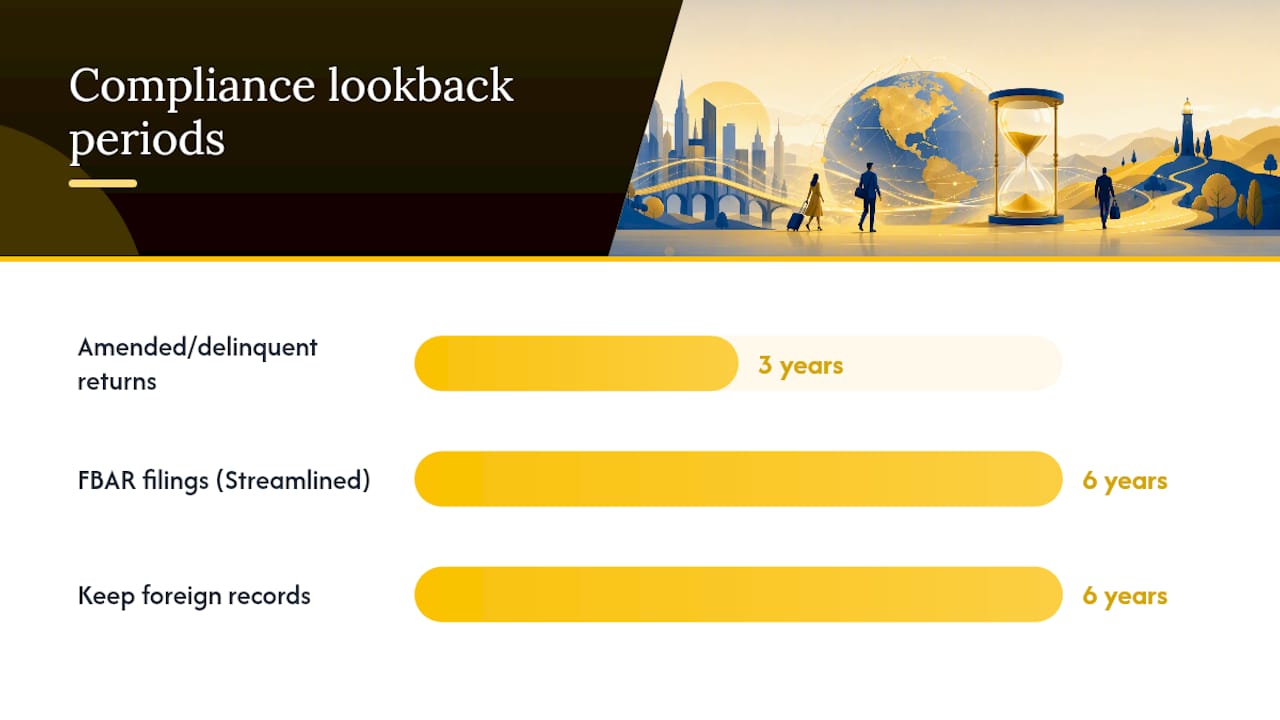
If you’ve fallen behind, the Streamlined Filing Procedures offer a structured way back for non-willful filers: three years of amended or delinquent returns, six years of FBARs, a signed non-willfulness statement, and payment of any tax and interest owed, without the steeper penalties tied to standard late filing.
Pro Tip: Run your FEIE versus FTC numbers before December 31, not after. Once the tax year closes, you’ve lost the ability to adjust income timing, retirement contributions, or foreign tax payments that could have shifted which method saves you more.
Keep organized records of foreign tax returns, account statements, and prior U.S. filings for at least six years. That’s the lookback window most compliance remedies require, and scrambling to reconstruct five years of foreign bank statements from memory is a genuinely miserable way to spend a weekend.
When Tax Complexity Meets Citizenship Questions: Getting the Right Help
Filing your own dual citizenship taxes gets manageable once you understand FEIE, FTC, and the reporting forms above. But some situations call for a professional, and it’s worth knowing which kind you need. An international tax CPA or an expatriation attorney is the right call when you’re facing PFIC calculations on foreign investment accounts, weighing covered expatriate exposure before renouncing citizenship, or untangling a dual-status year with property sales or business income mixed in. Those are tax and legal decisions with real dollar consequences, and they belong with a licensed professional.
Some consulting firms solve an earlier problem: figuring out whether you or a family member actually qualifies for a second citizenship through ancestry in the first place, and then handling the document research, application assembly, and consulate coordination that process demands. If you’re the accidental American discovering these tax rules because a grandparent’s birth certificate just opened the door to an Italian or Irish passport, that eligibility and paperwork question is best handled by specialized citizenship consulting services rather than a CPA.
Before any consultation, whether with a tax professional or with us, gather your passports, the last few years of foreign tax returns, bank and investment statements, and copies of your Form 1040 filings. If you’re still at the stage of wondering whether you even qualify for citizenship by descent through a parent or grandparent, our citizenship eligibility assessment is the logical next step, and our citizenship by descent guide walks through how the process typically unfolds from there.
Sources
This article is general information, not a substitute for advice from a qualified financial advisor. Consult a qualified financial professional about your own circumstances before acting on anything here.
FAQ
Do Dual Citizens Have to Pay Taxes in Both Countries?
Not usually on the same income. The Foreign Tax Credit and Foreign Earned Income Exclusion are designed specifically to prevent double taxation, though you generally still must file a U.S. return even when no U.S. tax ends up owed.
What Is the New Rule About Dual Citizenship and Taxes?
There’s no sweeping new law changing the core framework: citizenship-based taxation, FEIE, FTC, FBAR, and FATCA all remain governed by the same IRS and FinCEN rules described in Publication 54, though thresholds and exclusion caps adjust annually for inflation.
What’s the Downside of Holding Dual Citizenship for Tax Purposes?
The main downside is paperwork, not extra tax in most cases: dual citizens face ongoing FBAR and FATCA reporting duties, potential PFIC complications on foreign investments, and the risk of steep penalties for missed disclosures even when zero tax is due.
Do You Lose Social Security if You Have Dual Citizenship?
No, dual citizenship alone doesn’t affect Social Security eligibility, and totalization agreements between the U.S. and many countries coordinate benefits and prevent double Social Security contributions for people working across both systems.
Can a Tax Treaty Let Me Skip U.S. Filing Entirely?
Rarely. Most U.S. tax treaties include a saving clause that preserves the IRS’s right to tax its citizens regardless of treaty terms, so a treaty with your other country of citizenship almost never eliminates your U.S. filing requirement.