
Dual citizenship enrollment for children is defined as the formal process of registering a minor with an ancestral country’s consulate or government authority to secure legal recognition of their nationality rights. The enrolling children dual citizenship process requires specific documents, verified eligibility, and often in-person appointments at a consulate. Parents who act early protect their children’s rights to live, work, and study across borders. This guide explains eligibility rules, required documents, common mistakes, and the long-term benefits of citizenship by descent for families planning ahead.
What eligibility criteria determine a child’s qualification for dual citizenship?
A child’s eligibility for dual citizenship depends primarily on the citizenship status of their parents at the time of birth. The most critical legal distinction is whether a parent holds citizenship “by descent” or “otherwise than by descent.” This difference shapes whether a child qualifies automatically or must go through a formal registration process.
Children born abroad to a parent who holds citizenship “otherwise than by descent” often qualify automatically for the second nationality. Children born to a parent who is a citizen “by descent” face stricter rules. They may need to apply through a discretionary route, which can be refused and often costs significantly more.

Generational limits add another layer of complexity. Many countries limit citizenship by descent to one or two generations born abroad. A child whose grandparent was the original citizen may not qualify at all without a formal application. Parents must verify the specific nationality law that applied at the child’s birth, not the current law, since rules change over time.
Country-specific rules vary widely:
- United Kingdom: A child born abroad to a British citizen “by descent” does not automatically become British. Registration applications can cost over £1,000 and may be refused on discretionary grounds.
- Germany: Children born to at least one German parent generally acquire German citizenship at birth, regardless of where they are born.
- Italy: Children born abroad to an Italian parent can claim Italian citizenship, but registration with the consulate is required within a set time window.
- Mexico: Children of Mexican nationals born abroad are entitled to Mexican nationality and can register at any Mexican consulate.
Pro Tip: Check the nationality law of the ancestral country as it stood on the date of your child’s birth. Laws change, and the rules in effect at birth are the ones that govern eligibility.
What documents and steps are necessary to register a child for dual citizenship?
Registering a child for dual citizenship follows a structured process. Each country has its own requirements, but the core documentation is consistent across most consulates.
Core documents parents typically need
- Child’s birth certificate (original and certified copies, apostilled where required)
- Parents’ passports and national identity documents (originals and photocopies)
- Parents’ own citizenship documents (naturalization certificates, passports, or birth certificates proving their nationality)
- Completed consular registration forms (specific to each country’s consulate)
- Certified translations of any document not in the consulate’s official language
- Proof of residence for the parent and child (utility bills, lease agreements)
Many consulates require 2 photocopies of every original document, physical presence of both the child and at least one parent, and government-issued photo ID for all adults present.
The apostille and translation requirement
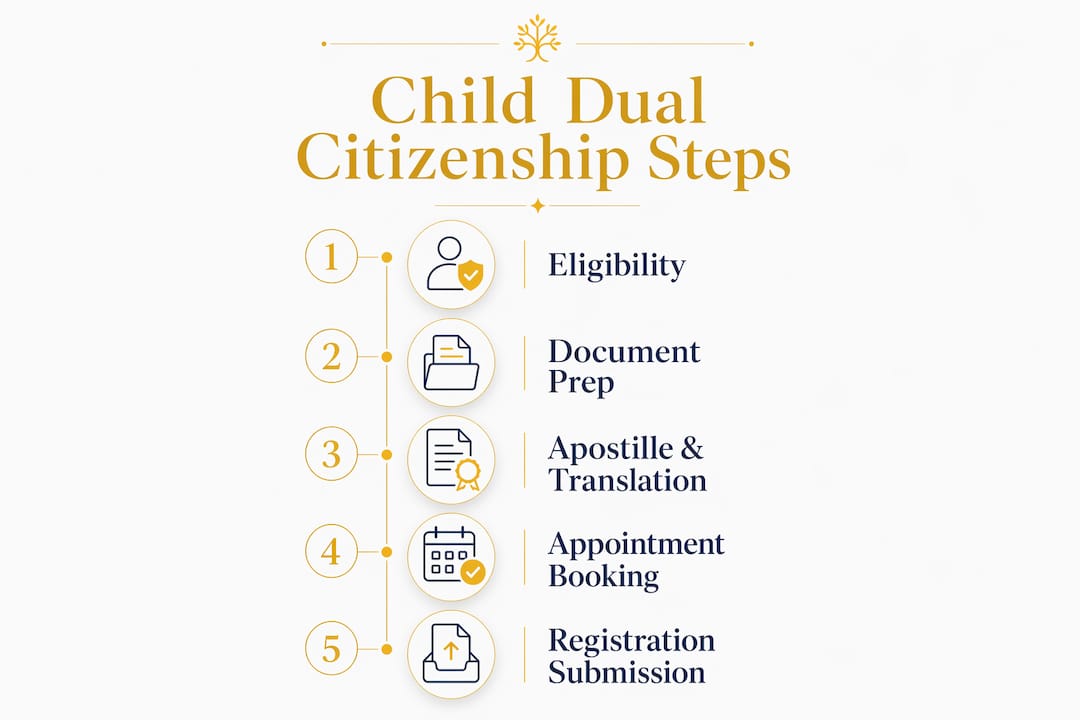
An apostille is a government-issued stamp that authenticates a document for use in another country under the Hague Apostille Convention. Most ancestral countries require apostilled birth certificates before they will process a registration. Certified translations must come from a translator recognized by the consulate, not just any bilingual professional.
Appointment booking and timing
Consulate appointment slots fill quickly. Italy’s registration process illustrates this well: consular slots may open only twice a month, meaning a delay of weeks can push a family past a registration deadline. Italy extended its registration window from 1 year to 3 years in 2026, but that window still closes. Mexico offers registration services free of charge at its consulates, making it one of the more accessible systems for families.
| Country | Registration window | Approximate fee | Key requirement |
|---|---|---|---|
| Italy | 3 years from birth (as of 2026) | Varies by consulate | Apostilled birth certificate, in-person |
| United Kingdom | No fixed window, but delays increase cost | Over £1,000 | Discretionary application, may be refused |
| Mexico | No strict deadline | Free | Consulate appointment, parent’s Mexican ID |
| Germany | No strict deadline | Low government fee | Parent’s German citizenship proof |
Pro Tip: Scan and store every document in a secure cloud folder the moment you receive it. Consulates lose paperwork. You should never be in a position where you cannot produce an original or a certified copy on short notice.
How can parents avoid common mistakes and legal complications in the enrollment process?
The single most expensive mistake parents make is assuming their child is automatically a dual citizen. Automatic citizenship and citizenship by registration are legally distinct. Assuming the former when the latter applies means a child may reach adulthood without valid documentation, which creates serious problems for passports, schooling, and employment.
Common pitfalls to avoid:
- Delaying registration past the deadline. Countries like Italy enforce strict windows. Missing them forces families into longer, more expensive discretionary processes.
- Submitting untranslated documents. A consulate will reject an application that includes documents not in the official language without a certified translation.
- Using unofficial translators. Only translators recognized by the specific consulate or government body are accepted.
- Ignoring generational limits. Parents who are themselves citizens by descent may not be able to pass citizenship to their children without a formal application.
- Failing to update records after legal name changes. A child’s name on a birth certificate must match all other documents exactly.
Delaying registration of children’s dual citizenship can cause legal complications including the inability to obtain passports or national identity documents, and can limit access to services like healthcare and schooling. Immediate registration preserves consistent legal identity and access to rights across borders.
Embassy rules change without much public notice. Italy’s shift from a 1-year to a 3-year registration window in 2026 is a clear example of legislative volatility that catches families off guard. Parents should check the official embassy portal of the ancestral country at least once a year. Setting a calendar reminder each January to review citizenship documents is a practical habit that costs nothing and prevents costly surprises.
What long-term benefits does dual citizenship provide for children and families?
Dual citizenship is a legal asset that compounds in value over a child’s lifetime. The rights it confers go well beyond travel convenience.
Key benefits for children who hold dual nationality include:
- The right to live and work in both countries without a visa or work permit, opening career options that single-nationality peers cannot access.
- Access to domestic tuition rates at universities in the ancestral country, which can represent savings of tens of thousands of dollars compared to international student fees.
- Healthcare access under the national health system of the second country, a significant financial protection for families who relocate or retire abroad.
- Consular protection from two governments when traveling internationally, providing a meaningful safety net during political or natural crises.
- Cultural and linguistic connection to family heritage, which research consistently links to stronger identity development in children.
Families increasingly pursue dual legal identity as a form of resilience against geopolitical and economic uncertainty. A second passport gives a child options that cannot be created quickly in a crisis. Experts in 2026 advise parents to treat dual citizenship as a foundational investment in a child’s future mobility, not simply a travel document. Countries offering citizenship by descent span Europe, Latin America, and beyond. Parents can review which countries qualify based on their own ancestry before starting the process.
Key Takeaways
Enrolling a child for dual citizenship requires verified eligibility, apostilled documents, timely consulate registration, and a clear understanding of whether citizenship is automatic or requires a formal application.
| Point | Details |
|---|---|
| Eligibility depends on parent’s status | A parent’s citizenship type (“by descent” vs. “otherwise than by descent”) determines whether a child qualifies automatically or must apply. |
| Documents must be apostilled and translated | Birth certificates, parental IDs, and consular forms require apostilles and certified translations before submission. |
| Registration windows are strict | Countries like Italy enforce deadlines; missing them forces longer, more expensive discretionary applications. |
| Automatic citizenship is often a myth | Many children require formal registration even when parents assume citizenship passes automatically. |
| Dual citizenship compounds in value | Rights to work, study, and access healthcare in two countries grow more valuable as a child ages. |
Why I tell every parent to start this process the week their child is born
Parents consistently underestimate how fast registration windows close. I have worked with families who discovered their child’s Italian registration window had lapsed by three months, turning a straightforward consulate appointment into a multi-year legal process. The paperwork burden at that stage is not just inconvenient. It is genuinely disruptive to family plans.
The other pattern I see repeatedly is parents who did the research, gathered the documents, and then waited. They waited for a “better time,” for a planned trip abroad, or for the child to be old enough to travel easily. Consulates do not accommodate personal timelines. The rules exist on the government’s schedule, not yours.
My strongest advice is to treat citizenship documentation the same way you treat a birth certificate or a Social Security card. Archive it from day one. Keep both digital and physical copies of every apostilled document, every consulate correspondence, and every certified translation. The families who do this never scramble. The ones who don’t often spend years and significant money reconstructing a paper trail that should have been simple.
Annual reviews matter too. I check the embassy portals of the relevant countries every january for clients who are mid-process. Laws shift. Italy’s window extension in 2026 is a good example of a change that helped families who were paying attention and caught others completely off guard. Proactive monitoring is not paranoia. It is the only way to stay ahead of regulatory changes that can affect your child’s rights.
— Audra
How Rootsrecoveredllc supports families through the citizenship enrollment process
Rootsrecoveredllc specializes in citizenship by descent services for parents who want expert guidance without the guesswork of navigating consular bureaucracy alone. The firm handles document authentication, legal verification, and direct consulate liaison on behalf of families at every stage of the process.
From the initial eligibility assessment through final application submission, Rootsrecoveredllc provides transparent pricing and personalized support. The team has established relationships with European consulates and a proven track record of successful applications. Parents who want to understand their child’s eligibility can start with a review of what citizenship by descent means for their specific family heritage. Rootsrecoveredllc removes the uncertainty and handles the details so parents can focus on what matters most.
FAQ
What is the first step in enrolling a child for dual citizenship?
The first step is verifying your child’s eligibility based on your own citizenship status and the nationality law of the ancestral country at the time of your child’s birth. Eligibility determines whether registration is automatic or requires a formal application.
Does dual citizenship apply to minors automatically?
Not always. Children born abroad to a parent who is a citizen “by descent” often need a formal registration application rather than receiving citizenship automatically. Parents should verify the specific rules of the ancestral country before assuming their child qualifies.
What documents are required for child dual citizenship registration?
Most consulates require the child’s apostilled birth certificate, parents’ passports and citizenship documents, certified translations of foreign-language documents, and completed consular registration forms. Physical presence of the child and at least one parent is commonly required.
How long does the dual citizenship enrollment process take for children?
Timelines vary by country and consulate workload. Appointment slots in some countries open only twice a month, so the process can take several months from document preparation to final registration. Starting as early as possible after birth is the most reliable way to avoid delays.
What happens if parents miss the registration deadline?
Missing a registration deadline typically forces families into a discretionary application process, which is longer, more expensive, and can be refused. In the UK, for example, late applications can cost over £1,000 and carry no guarantee of approval.