
If you have a parent, grandparent, or in some cases an earlier ancestor who was a citizen of another country, there is a real chance you already qualify for a second passport through citizenship by descent, the legal principle known as jus sanguinis (right of blood). This is not a discretionary grant. As Citizenship Network explains, descent claims are typically administrative recognitions of a status you already hold, not applications for something new. The immediate next step is a focused eligibility assessment: map your lineage to the rules of the relevant country, confirm your ancestor’s citizenship was never broken, and gather the key documents that prove the chain.
Here is what you need to do right now:
- Identify the qualifying ancestor and their country of origin.
- Confirm they did not naturalize as a U.S. citizen before the birth of the next generation in the chain.
- Request a formal citizenship eligibility assessment before investing time or money in documents.
Key Takeaways
Citizenship by descent is often the fastest and most affordable path to a second passport when your lineage qualifies, and the paper trail you build is the single greatest determinant of success.
| Point | Details |
|---|---|
| Descent is a recognition, not a grant | Most countries treat descent claims as confirming a status you already hold, making the process administrative rather than discretionary. |
| Paper trail determines success | Every generation needs long-form vital records, apostilles, and certified translations; DNA is not accepted as legal proof. |
| Costs range from $500 to $10,000 | Budget for government fees, document retrieval, apostilles, translations, and consultant fees across a 6–24 month timeline. |
| U.S. obligations remain in full | The U.S. requires use of a U.S. passport at U.S. borders and enforces FBAR/FATCA reporting regardless of a second nationality. |
| Roots Recovered, LLC handles end-to-end | The firm covers eligibility through passport issuance, with transparent pricing and established consulate connections for U.S. families. |
Table of Contents
- Who typically qualifies for citizenship by descent?
- What does the step-by-step process look like?
- What documents do you need for a descent claim?
- How long does it take, and what does it cost?
- Which countries offer common ancestry routes?
- How does a descent claim work for children and spouses?
- What are the U.S. legal and tax implications?
- Why hire an end-to-end citizenship consultant?
- A short checklist to start your application today
- Roots Recovered, LLC: end-to-end consulting for U.S. families
- Sources
Who typically qualifies for citizenship by descent?
Most countries tie eligibility to a parent or grandparent, but the rules vary sharply. Ireland allows claims through a grandparent via the Foreign Births Register. Italy’s jure sanguinis route has historically reached back multiple generations, though Italy’s 2025 reforms introduced generational limits and ongoing judicial review. Poland and Hungary often permit claims with no generational ceiling, provided the chain of citizenship is unbroken. Germany’s Article 116 restoration program applies specifically to descendants of those stripped of citizenship during the Nazi era.
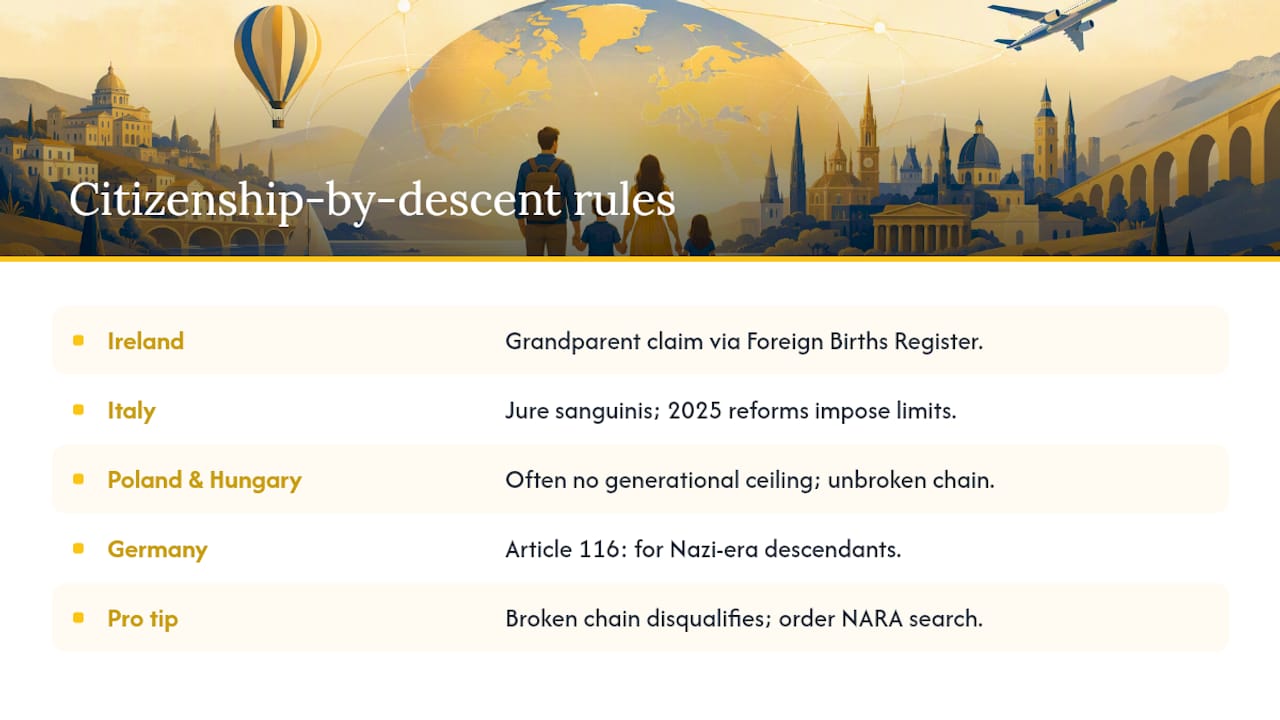
The single most common disqualifier is a broken chain: if your ancestor naturalized as a U.S. citizen before your parent (or you) were born, citizenship by descent typically did not pass. The order of events matters more than the bloodline itself.
Pro Tip: Order a NARA (National Archives) or USCIS no-record search for your ancestor early. Confirming they never naturalized, or pinpointing the exact naturalization date, is the fastest way to validate or rule out your claim before you spend months sourcing foreign documents.
What does the step-by-step process look like?
The path from family history to a second passport follows four clear phases. Knowing where each one begins and ends helps you understand where a consultant’s involvement pays off most.
- Eligibility assessment. Map the qualifying ancestor to the target country’s rules. Confirm generational limits, the ancestor’s citizenship status at the relevant birth dates, and whether any naturalization event broke the chain.
- Document sourcing and verification. Collect long-form birth, marriage, and death certificates for each generation. Obtain naturalization records or no-record confirmations. Apply apostilles to U.S.-issued documents and commission certified translations of foreign-language records. This phase is where most delays occur.
- Application preparation and submission. Assemble the complete file and submit to the relevant consulate (for most U.S.-based applicants) or, in some cases, directly to a civil registry office in the country. Consulate filings require precise formatting; errors at this stage cause rejections that can add months to the timeline.
- Recognition, passport application, and family enrollment. Once citizenship is recognized, you apply for the passport itself. Minor children can often be enrolled on the same recognition, and a consultant can coordinate their documents in parallel to avoid a second round of filings. Read more about what to expect at a consulate interview before your appointment.
What documents do you need for a descent claim?
Success depends on a complete paper trail, not DNA. Every generation in the chain needs documentation.
- Vital records for each generation: long-form (not abstract) birth certificates, full marriage certificates showing both parties’ full names, and death certificates where applicable.
- Proof of the ancestor’s citizenship: a foreign birth certificate, a foreign passport, or naturalization records from the country of origin.
- Non-naturalization evidence: NARA or USCIS no-record search results confirming the ancestor never became a U.S. citizen, or a naturalization certificate showing the date (to determine whether citizenship passed before or after the critical birth).
- Name-change records: court orders or marriage certificates that explain any surname discrepancies across generations.
- Apostilles: required on U.S.-issued documents for use abroad under the Hague Apostille Convention.
- Certified translations: all foreign-language documents must be translated by a certified translator; most consulates specify their own standards.
Pro Tip: Start domestic searches and apostille requests immediately. Some foreign civil archives take three to six months to respond, and U.S. vital records offices in certain states have multi-week backlogs. Getting domestic documents apostilled while you wait for foreign records keeps the project moving.
How long does it take, and what does it cost?
Descent claims typically cost between $500 and $10,000 and take 6–24 months for many routes, though country backlogs can push timelines longer. Ireland’s Foreign Births Register, for example, has experienced significant processing delays. Italy’s current judicial review environment adds uncertainty to timelines there.
Cost categories to budget for:
- Government fees: consulate filing fees and passport issuance fees, which vary by country.
- Document retrieval: vital records from U.S. and foreign archives, NARA searches, and apostille fees.
- Translations: certified translation of each foreign-language document.
- Consultant or legal fees: end-to-end consulting engagements that cover eligibility through passport issuance.
- Travel or in-country costs: some countries require an in-person appearance or a brief residency period.
For comparison, naturalization through residency typically takes 5–10 years, and citizenship-by-investment programs move faster but require significant capital. Citizenship by descent is often the most cost-effective route when you qualify, because the primary investment is time and document procurement rather than large financial outlays. For non-EU alternatives, residency-to-citizenship pathways in countries like Paraguay offer a different timeline and cost structure worth comparing.
Which countries offer common ancestry routes?
Ireland, Italy, Poland, Germany, Portugal, and others all operate ancestry-based programs, each with distinct rules. Here is a quick orientation:
- Ireland: Grandparent route via the Foreign Births Register. Ireland permits dual citizenship with the U.S. Expect processing backlogs. See the Irish citizenship via the Foreign Births Register guide for current timelines.
- Italy: Jure sanguinis historically had no generational limit, but 2025 reforms introduced caps and remain under judicial review. Apply promptly while the legal landscape is still being settled.
- Poland: No generational limit if the chain is intact and documented. One of the more accessible routes for Americans with Polish ancestry.
- Germany: Article 116 applies to descendants of those denaturalized between 1933 and 1945; a separate Section 15 route covers some other cases.
- Portugal: Rules adjusted in 2026 to modify language and residence requirements for certain applicants; verify current criteria before collecting documents.
- Canada: Citizenship by descent is available to the first generation born abroad to a Canadian citizen parent. Explore the Canadian route if you have a Canadian-born parent.
Most of these countries permit dual citizenship with the United States. Germany is a notable exception with stricter rules, though the Article 116 restoration path is a specific carve-out. Always start with the country of your qualifying ancestor and check which countries fit your lineage before committing to a document collection strategy.
How does a descent claim work for children and spouses?
Children are often the most straightforward beneficiaries of a parent’s successful descent claim. In many countries, once a parent’s citizenship is recognized, minor children can be registered simultaneously or shortly after, inheriting the same nationality. The practical steps involve submitting the child’s birth certificate (apostilled and translated if needed) alongside or immediately after the parent’s recognition file.

Spouses are a different matter. Citizenship by descent does not extend to spouses; they are not blood relatives of the qualifying ancestor. Most countries offer a separate naturalization route for spouses of citizens, which typically requires a period of marriage and sometimes residency. If you are planning a family application, timing matters: completing the parent’s recognition first, then enrolling children, is usually the most efficient sequence.
What are the U.S. legal and tax implications?
The United States permits dual citizenship and does not require you to renounce your U.S. passport to hold another. However, there are clear obligations you must understand before activating a second nationality.
The U.S. requires its citizens to use their U.S. passport when entering or leaving the United States, regardless of what other passports they hold. Additionally, U.S. tax reporting obligations, including FBAR (Report of Foreign Bank and Financial Accounts) and FATCA (Foreign Account Tax Compliance Act) requirements, remain fully in effect after you acquire another nationality. Thresholds and filing requirements depend on your specific financial situation.
Usa these obligations directly. This article provides general information, not legal or tax advice. If acquiring a second passport will involve foreign bank accounts, foreign income, or residency abroad, consult a cross-border tax advisor before you finalize your application.
Why hire an end-to-end citizenship consultant?
Professional support consistently shortens timelines and reduces rejection risk, because many descent claims fail on small documentary errors rather than genuine ineligibility. A qualified consultant delivers:
- A thorough eligibility audit that maps your lineage to current country rules.
- Archive research across U.S. and foreign repositories.
- Apostille and certified translation coordination.
- Complete application assembly in the format each consulate requires.
- Consulate interview preparation and follow-through until passport issuance.
When evaluating consultants, look for a proven success rate, established consulate relationships, transparent pricing with clear deliverables, and a process that covers the full scope from eligibility through passport in hand. Roots Recovered, LLC meets all of these criteria and specializes exclusively in citizenship-by-descent engagements for U.S. families.
The DIY route saves on consultant fees but carries real risk. A missing apostille, an incorrect translation, or a misunderstood generational rule can result in a rejection that adds a year or more to your timeline. For most families, the cost of a consultant is far lower than the cost of a failed application and a restart.
A short checklist to start your application today
Complete these six steps before or during your first consultant conversation:
- Identify the qualifying ancestor: full name, birth country, approximate birth and death dates.
- Gather your own long-form birth certificate and current U.S. passport.
- Request a NARA or USCIS no-record search (or locate the ancestor’s naturalization certificate) to confirm or date any naturalization event.
- Order long-form vital records for each generation between you and the qualifying ancestor.
- Apostille any U.S.-issued documents you have already collected.
- Request a formal eligibility assessment from Roots Recovered, LLC to get a clear verdict before investing further.
Roots Recovered, LLC: end-to-end consulting for U.S. families
Roots Recovered, LLC gives U.S. families a single point of accountability from the first eligibility question to the moment a second passport arrives. The firm handles eligibility audits, archive research across multiple countries, apostille and translation coordination, full application assembly, and consulate follow-through. Clients receive transparent pricing, a clear scope of deliverables, and multilingual support throughout. The initial engagement begins with a paid eligibility assessment that produces a concrete verdict on your ancestor’s qualifying status and a document roadmap for your specific case.
To get started, visit the citizenship-by-descent services page or request your eligibility assessment directly at Rootsrecoveredllc. A clear answer on whether you qualify is the most valuable first step you can take.
Sources
- Usa
- How to get dual citizenship to live, work, or retire abroad | Condé Nast Traveler
- Second Passport US Citizens 2026: 30+ Countries Guide | YouResidency
- How to get EU citizenship by descent | Expatsi
- Citizenship by Descent: Complete Guide 2026 | Citizenship Network
This article is general information, not a substitute for advice from a qualified lawyer. Consult a qualified legal professional about your own circumstances before acting on anything here.