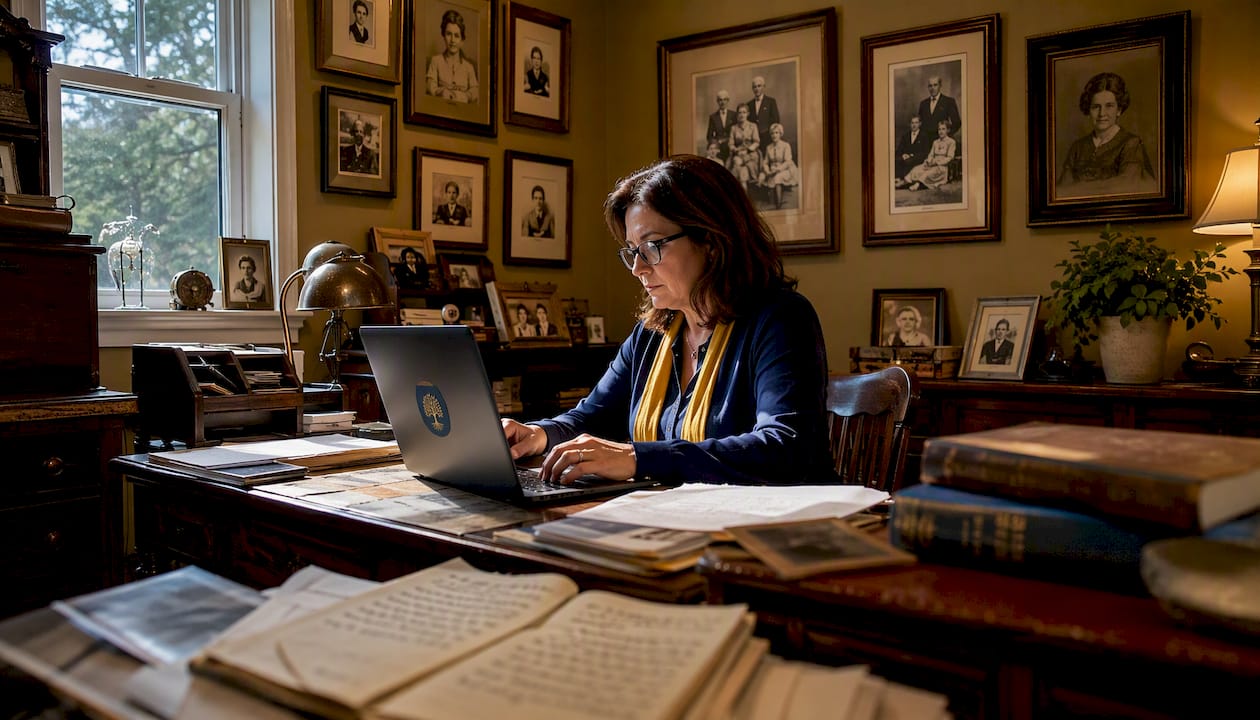
For most family-history researchers, the smartest starting point is FamilySearch for free global breadth, Ancestry for deep U.S. records, and MyHeritage or Findmypast when your ancestors lived in Europe or the British Isles. No single platform covers everything, which is why authoritative comparisons consistently identify a “Big Four” and recommend layering platforms by geography and time period.
Quick shortlist:
- Best free baseline: FamilySearch — global collections, no subscription required
- Best for U.S. research: Ancestry — deepest census, directory, and newspaper holdings
- Best for European records: MyHeritage — multilingual interface, DNA integration, photo tools
- Best for UK and Irish research: Findmypast — concentrated British Isles parish and newspaper collections
- Best for military records: Fold3 — specialized service records, pension files, and unit histories
- Best for historic newspapers: Newspapers.com — extensive digitized runs across U.S. communities
- Best free government archive: National Archives (NARA) — authoritative federal records and research guides
The most effective strategy is hybrid: use FamilySearch as your free baseline, then add one paid specialist matched to where your ancestors lived. When research needs to support a legal application, such as a citizenship-by-descent claim, Roots Recovered, LLC provides end-to-end consulting that goes well beyond what any genealogy site can offer.
Table of Contents
- How do the best genealogy sites compare at a glance?
- Is Ancestry worth the subscription for U.S. research?
- Why FamilySearch is the essential free starting point
- When does MyHeritage outperform the competition?
- Findmypast is the specialist for British and Irish ancestry
- Fold3 and Newspapers.com: when specialist archives beat general platforms
- Free government and community resources you should check first
- How do you pick the right genealogy site for your research?
- When genealogy sites aren’t enough: hiring professional help
- Key Takeaways
- Roots Recovered, LLC turns genealogy research into a citizenship application
- Authoritative sources and where to go next
How do the best genealogy sites compare at a glance?
| Site | Best for | Geographic coverage | Key record types | Pricing | Tree & collaboration | DNA tools | Search power |
|---|---|---|---|---|---|---|---|
| FamilySearch | Free global baseline | Global, all periods | Census, vitals, immigration, military | Free | Shared global tree | No | Strong; browse-only images require affiliate access |
| Ancestry | Deep U.S. research | U.S.-heavy; some international | Census, directories, newspapers, immigration | Subscription ($) | Personal + public trees | Yes (AncestryDNA) | Excellent; fast household browsing |
| MyHeritage | European & multilingual research | Strong Europe; global | Vitals, immigration, some census | Freemium to paid | Personal + collaborative | Yes (MyHeritage DNA) | Good; auto-translation feature |
| Findmypast | UK & Irish records | British Isles specialist | Parish registers, census, newspapers | Subscription ($) | Personal trees | No | Strong for UK/Irish filters |
| Fold3 | U.S. military records | U.S. military focus | Service records, pensions, unit histories | Subscription ($) | No | No | Good for military-specific search |
| Newspapers.com | Historic newspapers | U.S. national & local | Obituaries, local news, notices | Subscription ($) | No | No | Strong OCR search |
| NARA | Federal primary sources | U.S. federal records | Census, military, immigration, land | Free | No | No | Research guides; in-person access |
| JewishGen | Jewish genealogy | Eastern Europe, global Jewish communities | Community records, town guides, Holocaust-era | Free (some paid) | No | No | Specialized search tools |
| ScotlandsPeople | Scottish official records | Scotland | Statutory records, parish registers | Pay-per-view | No | No | Official government portal |
| Geni | Collaborative world tree | Global | User-contributed profiles | Freemium | Shared world tree | No | Profile merging |
| Find A Grave | Cemetery & burial info | Global | Memorials, burial records, photos | Free | No | No | User-contributed |

A few things stand out in this comparison. FamilySearch is the only major platform that is entirely free and covers every continent. Ancestry’s interface advantage for U.S. census browsing is real: both platforms hold complete U.S. federal census runs from 1790 through 1950, but Ancestry’s household-browsing tools make cluster analysis faster. ScotlandsPeople operates on a pay-per-view model rather than a subscription, which suits researchers who need only a handful of Scottish records.
Is Ancestry worth the subscription for U.S. research?
Ancestry is the right choice when your research centers on American ancestors from the colonial era through the mid-twentieth century. Its depth in U.S. census records, city directories, immigration passenger lists, and newspaper archives is unmatched among subscription platforms.
Pros:
- Complete U.S. federal census runs (1790–1950) with fast household and neighbor browsing
- Integrated AncestryDNA with record hints tied to DNA matches
- Large user-submitted tree database that can surface leads quickly
- Newspapers.com access bundled in some subscription tiers
- Mobile app available for iOS and Android
Cons:
- Subscription cost adds up, especially for international record access
- User-submitted trees contain errors; always verify against primary sources
- International collections are thinner than U.S. holdings
Ancestry offers a free trial period, and some records are viewable without a subscription. The standard subscription unlocks U.S. records; a higher tier adds international collections. If your ancestors are primarily American, the standard tier is usually sufficient.
Pro Tip: Use Ancestry’s “1940 Census Community Project” search filters alongside the neighbor-browsing feature to identify entire household clusters — this speeds up finding relatives who may have lived nearby and shared the same surname variants.
Why FamilySearch is the essential free starting point
FamilySearch is the best free genealogy site available, full stop. Operated by The Church of Jesus Christ of Latter-day Saints, it provides access to billions of records at no cost, covering every inhabited continent and spanning centuries of vital, census, military, and immigration documents.
Pros:
- Entirely free, no subscription required
- Global collections including non-English and non-Western records
- Shared global Family Tree that reduces duplicate research
- Affiliate library access unlocks additional contracted record sets
Cons:
- Many collections exist only as browse-only digitized images, not indexed names
- The shared tree model means other users can edit your entries
- Some contracted records are only accessible at affiliate libraries or Family History Centers
The distinction between indexed and browse-only collections matters more than most beginners realize. Indexed records appear in keyword searches; browse-only images require you to navigate film-by-film through a catalog. Many critical collections, particularly for Eastern Europe, Latin America, and pre-1900 records, exist only in browse-only format.
Best for: Researchers who want a comprehensive, no-cost baseline before committing to a paid subscription, and anyone tracing non-U.S. or non-English ancestry.
Pro Tip: Before paying for any subscription, check whether your local public library or genealogy society is a FamilySearch affiliate. Affiliate libraries unlock contracted record sets that are otherwise paywalled, often including the same collections sold on commercial platforms.
When does MyHeritage outperform the competition?
MyHeritage earns its place in the Big Four specifically for researchers tracing European lines or working with non-English records. Its automatic translation feature is genuinely useful when you encounter German church registers, Polish civil records, or Italian vital documents.
Pros:
- Strong European record collections, particularly for Central and Eastern Europe
- Automatic translation of foreign-language records and interfaces
- DNA integration that links matches to record hints and tree suggestions
- Photo-enhancement and colorization tools (useful for identifying relatives in old photographs)
- Freemium model lets you build a tree and search basic records before paying
Cons:
- Full record access requires a paid subscription
- U.S. collections are thinner than Ancestry’s
- DNA database is smaller than AncestryDNA’s
MyHeritage’s workflow linking DNA matches to records and tree suggestions is particularly effective for researchers who have already tested their DNA and want to connect biological matches to documentary evidence. The photo tools are a bonus rather than a core research feature, but they can help confirm family identities across generations.
Findmypast is the specialist for British and Irish ancestry
If your family roots run through England, Scotland, Ireland, or Wales, Findmypast is the platform you need. Its partnership with the British Newspaper Archive and its concentrated Irish civil registration collections give it a clear advantage over generalist platforms for British Isles research.
Pros:
- Deepest curated collections for Irish civil registration and UK parish records
- British Newspaper Archive partnership provides extensive historic newspaper runs
- Strong search filters designed specifically for British and Irish naming conventions
- Military records for British armed forces
Cons:
- Limited value for non-British Isles research
- Subscription required for full access
- Interface can feel less polished than Ancestry’s
Findmypast’s focused UK and Irish collections and its British Newspaper Archive partnership make it the specialist choice for those regions. If your ancestor was born in County Cork in 1845 or baptized in a Yorkshire parish in 1780, Findmypast will often surface records that Ancestry and FamilySearch simply do not hold.
Best for: Researchers with English, Scottish, Irish, or Welsh ancestors who need older parish registers, local newspapers, and civil registration records.
Fold3 and Newspapers.com: when specialist archives beat general platforms
Some research questions require a dedicated archive rather than a generalist subscription. Military records and historic newspaper collections are the two clearest cases where specialist repositories hold unique material that general databases often lack.
- Fold3 concentrates on U.S. military documentation: service records, pension files, draft registrations, and unit histories. If you are researching a Civil War soldier, a World War I draftee, or a Vietnam-era veteran, Fold3 often provides original document images that are not available on Ancestry or FamilySearch. It operates on a subscription model, and some collections are also accessible through a NARA partnership.
- Newspapers.com digitizes local and national American newspapers across hundreds of communities, making it the strongest single source for obituaries, marriage notices, legal announcements, and local-event coverage. Its OCR search is strong enough to find a surname buried in a column of small print. Some Ancestry subscription tiers bundle Newspapers.com access, so check your current plan before purchasing separately.
Both archives complement the Big Four rather than replace them. Think of them as targeted tools you add for a specific brick-wall problem, not as permanent subscriptions you maintain year-round.
Free government and community resources you should check first
Paid subscriptions are not always necessary. Several government and volunteer-driven resources provide free access to records that commercial platforms either do not hold or charge to view.
Government archives:
- National Archives (NARA): The authoritative source for U.S. federal records, including census microfilm, military service records, immigration files, and land patents. NARA’s genealogy research guides walk you through which record groups to request and how to order copies.
- New York Public Library (NYPL): — Extensive local-history collections for New York City ancestors, with digitized finding aids and research guides.
Volunteer and community resources:
| Resource | What it offers | Cost |
|---|---|---|
| USGenWeb / WorldGenWeb | State, county, and country-level transcriptions and indexes | Free |
| Cyndi’s List | Categorized directory of thousands of specialty genealogy links | Free |
| JewishGen | Community-curated Jewish records, town guides, Holocaust-era databases | Free (some paid features) |
| BillionGraves | GPS-tagged, crowd-sourced cemetery photos and indexes | Free |
| Find A Grave | User-contributed memorial database with burial photos | Free |
| Access Genealogy | U.S. state-focused transcriptions and guides | Free |
| FreeUKGenealogy | Volunteer-created UK parish and local indexes | Free |
| Freedmen’s Bureau records | Post-Civil War records for African American research | Free (via partner sites) |
| Allen County Public Library | Large physical and digital genealogy collections | Free (in-person and online) |
| Legacy.com | Obituary aggregator for modern death notices | Free |
Volunteer-driven resources like USGenWeb, NARA, and Cyndi’s List remain indispensable because they often index local records that commercial platforms have not digitized. Before purchasing a subscription, run your surnames through these free sources. You may find the record you need without spending a dollar.
Pro Tip: NARA’s HistoryHub community forum at historyhub.history.gov connects you with NARA staff and experienced researchers who can point you to specific record groups — a faster route than browsing the full catalog alone.
How do you pick the right genealogy site for your research?
Matching a platform to your ancestor’s geography and time period is more effective than defaulting to the most popular site. Work through these steps before committing to a subscription.
- Define your geographic and time scope. Where was your ancestor born, and when? A 19th-century Irish immigrant requires different platforms than a colonial Virginia planter or a 20th-century Polish arrival.
- Search each major site’s catalog for relevant collections. FamilySearch, Ancestry, and MyHeritage all publish collection catalogs. Check whether the specific record type you need (parish register, census year, military draft) is actually held before subscribing.
- Test with free indexes and trial subscriptions. Most paid platforms offer a free trial. Use it to run your key surnames and locations before committing to a full billing cycle.
- Cross-verify in primary sources. User-submitted trees and transcriptions contain errors. Always confirm a finding in the original document image, and note the source with full citation details.
- Layer platforms by geography. Researchers typically need two or three platforms for thorough work; a single site almost always misses key collections.
Questions to ask before choosing:
- What country and region did my ancestor come from?
- What language were local records kept in?
- What record types survive for that place and period (church, civil, military, land)?
- Does the platform hold those specific collections, or does it only index a subset?
Cost management tips:
- Subscribe to one platform at a time, complete your research goals, then cancel before the next billing cycle.
- Purchase individual records on pay-per-view platforms (ScotlandsPeople, some NARA orders) rather than subscribing when you need only a handful of documents.
- Check whether your public library provides free access to Ancestry, HeritageQuest, or other platforms through a library card.
When genealogy sites aren’t enough: hiring professional help
Online genealogy research tools are powerful, but they have a clear boundary. When your research goal is a legal application, such as claiming citizenship by descent, the work shifts from discovery to verified documentation, and that shift usually requires professional help.
Citizenship-by-descent applications require rigorous, verified document collection and end-to-end management that goes well beyond searching a database. A genealogy site can help you find a birth record; it cannot obtain a certified copy, arrange an apostille, coordinate with a foreign consulate, or manage the legal submission process.
Signs you need a professional consultant:
- Your research goal is a citizenship or nationality application, not just family history
- Records exist in a foreign language or archive you cannot access directly
- Documents require official certification, apostilles, or notarized translations
- You need to coordinate with a consulate or government agency in another country
- The application involves multiple generations of lineage documentation
What a consultant manages:
- Eligibility assessment to confirm you qualify before any documents are ordered
- Targeted document research and procurement from foreign archives
- Official translations and apostille coordination
- Preparation and submission of the citizenship application
- Direct communication with consulates throughout the process
Pro Tip: Start with a citizenship eligibility assessment before ordering any documents. Confirming eligibility first prevents spending money on certified records for an application that does not qualify.
Key Takeaways
The most effective genealogy research strategy combines FamilySearch as a free baseline with one paid specialist platform matched to your ancestor’s geography, and brings in professional consulting when the goal is a legal citizenship application.
| Point | Details |
|---|---|
| Start with FamilySearch | It is entirely free, globally comprehensive, and the right first stop before any paid subscription. |
| Match platform to geography | Use Ancestry for U.S. records, MyHeritage for Europe, and Findmypast for British and Irish ancestry. |
| Add specialists for specific needs | Fold3 for military records and Newspapers.com for historic newspapers outperform generalist platforms on those record types. |
| Use free resources first | NARA, USGenWeb, Cyndi’s List, and JewishGen often hold records that commercial platforms do not index. |
| Roots Recovered, LLC for legal applications | When genealogy research must support a citizenship-by-descent application, Roots Recovered, LLC provides end-to-end consulting from eligibility assessment through consulate submission. |
Roots Recovered, LLC turns genealogy research into a citizenship application
Genealogy sites give you the records. Roots Recovered, LLC turns those records into a successful citizenship-by-descent application. The firm handles every step that falls outside a database search: eligibility assessment, targeted document procurement from foreign archives, official translations, apostille coordination, and direct consulate communication.
Services include:
- Ancestral eligibility assessment to confirm qualification before documents are ordered
- Document research and certified procurement from European and Canadian archives
- Preparation and submission of the full citizenship application
- Consulate coordination and multilingual support throughout the process
- Guidance on types of ancestral citizenship programs across eligible countries
If your family history research has surfaced a potential claim to European or Canadian citizenship, the next step is a formal eligibility review. Explore Roots Recovered’s citizenship-by-descent services to understand what the process involves and how the firm supports you from the first document to the final approval.
Authoritative sources and where to go next
The resources below are reliable starting points for deeper research and primary-source verification.
- NARA Genealogy Research Guides — Official guides to federal record groups, ordering procedures, and research strategies for U.S. ancestors.
- Library of Congress — Digitized historical newspapers (Chronicling America), maps, and federal publications available free online.
- NARA HistoryHub — Community forum staffed by NARA archivists; useful for identifying specific record groups and research strategies.
- Genealogy Authority: Online Databases Compared — Platform-by-platform comparison of major genealogy databases including census coverage and interface features.
- Roots Recovered, LLC: Citizenship by Descent Explained — Overview of what citizenship by descent means, which countries permit it, and how professional consulting supports the application process.