
A citizenship eligibility assessment is the official process by which a government verifies your legal right to citizenship by descent through documented lineage and defined legal criteria. This process, formally called a descent citizenship claim, requires more than a family story. Authorities demand certified proof, an unbroken chain of vital records, and in many countries, evidence that your ancestor met specific physical presence requirements. Understanding what determines descent citizenship eligibility before you apply saves time, money, and the risk of a formal refusal.
What are the main criteria used to assess citizenship eligibility by descent?
Eligibility for citizenship by descent rests on three pillars:
- Documented lineage,
- Physical presence, and
- Good character.
Each country weighs these differently. Some countries do not require proof of good character or physical presence at all. Others do. We’ll go over all of them in this post.
Physical presence requirements are the most country-specific factor. Canada’s law, updated effective December 15, 2025 under Bill C-3, now requires a substantial connection test of 1,095 cumulative days of physical presence in Canada before a child’s birth–but only for people born after December 15, 2025. Those days do not need to be consecutive, which eases the burden of proof somewhat. Still, you must document them with official records, not personal estimates.
In other words, for anyone born before December 15, 2025, physical presence is not a factor when it comes to citizenship by descent. But for people born after that date–like babies born to people who are themselves seeking citizenship by descent–it is.
One other country with a physical presence requirement (in name only) was Slovakia, which required Slovak citizenship by descent applicants to obtain a residency permit as a formality while undergoing the citizenship by descent process. Applicants did not have to move to Slovakia: instead, this was a bureaucratic formality.
As of July 2026, this may no longer be required.

Moving away from citizenship by descent for a moment, the United States takes a similar approach for naturalization applicants. US law requires at least 30 months of physical presence within the five-year qualifying period. Absences of six months or longer trigger a rebuttable presumption of residence abandonment. That means the burden shifts to you to prove you never intended to leave permanently.
The United Kingdom adds another layer. British citizenship applicants must pass the Life in the UK test and an English language assessment, in addition to meeting strict residence requirements. Good character is assessed across criminal records, tax compliance, and immigration history.
Here is a summary of the core criteria across these three countries:
- Documented lineage: Certified birth, marriage, and death certificates for every generation connecting you to the qualifying ancestor
- Physical presence: Minimum days in the country, which vary by jurisdiction and application type (not all citizenship by descent programs require this, and even then, not all applicants are subject to this)
- Continuous residence: Proof that the qualifying ancestor or applicant held residency at the key time (super important for programs like Poland, Latvia, Lithuania, and Slovakia)
- Good moral character: Clean criminal, tax, and immigration records, or full disclosure of any issues (only applicable in some citizenship by descent jurisdictions)
Pro Tip: Start your eligibility review by mapping out every generation between you and your qualifying ancestor before you gather a single document. Knowing the full chain first tells you exactly which records you need.
How does the documentation and proof process work?
The documentation process is where most citizenship by descent claims succeed or fail. Lawyers consistently emphasize that a certified paper trail built from government-issued vital records is the foundation of every successful claim. Family lore and genealogy website printouts carry no legal weight.
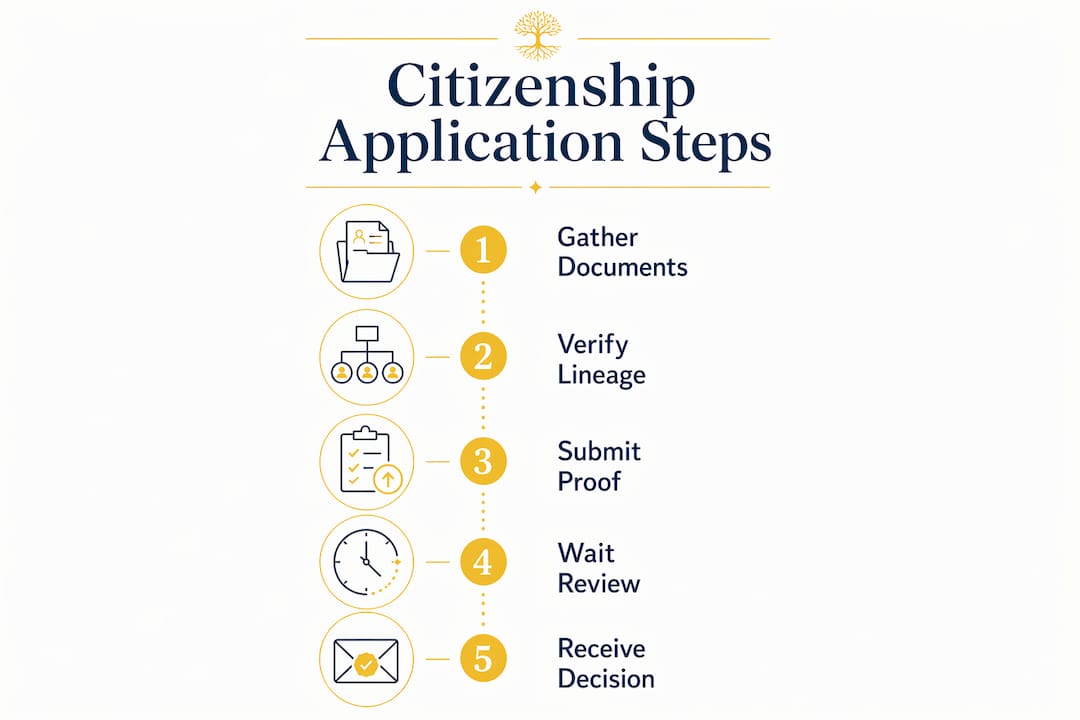
An unbroken chain of documents is mandatory. For Canadian descent claims, that means birth, marriage, and sometimes death or other certificates for every generation linking you to your Canadian ancestor. Missing even one document in that chain can cause immediate rejection or indefinite stalling of your application.
The standard document set for each generation typically includes:
- Birth certificate issued by the original government authority, not a hospital or church record
- Marriage certificate if the lineage passes through a married name change
- Death certificate for deceased ancestors in the chain
- Naturalization or citizenship records if the ancestor changed nationality at any point
Common pitfalls are predictable and avoidable. Many applicants rely on Ancestry.com printouts or family bibles as primary evidence. Canadian authorities have requested certificate surrender from some new citizens whose evidence did not meet current standards, and IRCC is moving towards “certified documents only” requirements. That is a serious consequence that underscores why unofficial records are never sufficient.
When official records are genuinely unavailable, you cannot simply explain the gap. A documented audit trail is mandatory. That means a written explanation plus concrete proof of your efforts to obtain the missing records from the original issuing authority. An explanation alone, without evidence of due diligence, leads to delays or outright refusal.
| Document type | Accepted source | Common mistake |
|---|---|---|
| Birth certificate | National or provincial vital statistics office | Hospital-issued copy or genealogy site printout |
| Marriage certificate | Civil registry or government archive | Church record without civil registration |
| Death certificate | Government vital records authority | Obituary or funeral home document |
| Naturalization record | National archives or immigration authority | Family copy without official seal |
Pro Tip: Request certified copies directly from the issuing government authority, not through third-party genealogy services. Many countries offer apostille certification, which simplifies cross-border document recognition.
What are common challenges applicants face and how can they prepare?
The citizenship eligibility assessment process involves both legal determinations and administrative reviews. Confusing the two is one of the most costly mistakes applicants make.
Your legal citizenship status, once established by statute, is settled law. The administrative review of your citizenship certificate is a separate process. Administrative reviews can yield inconsistent outcomes. In some cases, parents receive document review notices while children on the same application do not. That inconsistency does not change your underlying legal status. It means the administrative dispute may need to be resolved through a separate legal channel, including court if necessary.
Practical preparation steps include:
- Build an audit trail from day one. Keep copies of every document request, every response, and every communication with issuing authorities.
- Separate legal status from certificate review. If you receive a review notice, do not assume your citizenship is revoked. Consult a qualified immigration attorney before responding.
- Verify document authenticity. Some countries require apostille certification or notarized translations for foreign-language records.
Experienced immigration attorneys point out that separating the settled legal status from ongoing administrative certificate reviews is paramount to managing applications calmly and effectively. A review notice is not a revocation. It is an administrative dispute, and those disputes have defined resolution pathways.
How does the assessment affect your application timeline?
The citizenship eligibility assessment directly determines how long your application takes to process. Incomplete or insufficient evidence is the single biggest cause of delays.
Canadian citizenship applications process in approximately 12-14 months under normal circumstances. Poland takes 24+ months. We’ve had German citizenship clients get their citizenships in 4 months (though this may be an anomaly). Every program is different but the advice we usually give is: it’ll probably take longer than you think, but time will pass anyway–so why not let it pass after you’ve already filed your application?
The above timelines assume your documentation is complete and your eligibility criteria are clearly met. Missing or insufficient records and evidence can extend timelines significantly, sometimes by years.
The typical post-submission sequence looks like this:
- Initial review: Authorities check that your application is complete and all required documents are present.
- Eligibility assessment: Officers verify that your lineage, presence, and character evidence (if applicable) meets the legal standard.
- Follow-up requests: If evidence is insufficient, you receive a request for additional documentation. Failure to respond within the deadline results in refusal.
- Interview (where applicable): Some jurisdictions require an in-person interview, particularly when presence claims are complex or character issues exist.
- Decision: Approval, refusal, or a request for further review. Refusals include reasons, and most can be appealed through defined administrative or legal channels.
Submitting a complete, well-organized application from the start is the most effective way to stay within the standard processing window. Rootsrecoveredllc works with applicants to verify document completeness before submission, which reduces the risk of follow-up requests and delays. You can review Canadian descent citizenship requirements in detail to understand what a complete application looks like.
Key Takeaways
A successful citizenship by descent claim requires certified vital records, documented physical presence, and proactive handling of any character issues before submission.
| Point | Details |
|---|---|
| Certified documents only | Government-issued vital records are required; genealogy website printouts are never accepted. |
| Unbroken lineage chain | Every generation between you and the qualifying ancestor needs birth, marriage, and death certificates. |
| Physical presence evidence | Canada requires 1,095 cumulative days; the US requires 30 months within a five-year period. |
| Audit trail for missing records | Written explanation plus proof of document-request efforts is mandatory when records are unavailable. |
| Address character issues early | Disclosing tax, criminal, or immigration concerns before filing improves approval outcomes (where applicable) |
What we’ve learned from watching applicants get this wrong
After working through hundreds of descent citizenship cases, the pattern that causes the most preventable failures is the same every time. Applicants arrive with a compelling family story, a stack of Ancestry.com printouts, and complete confidence. The story is often true. The printouts are always insufficient.
The hardest conversation to have with a client is explaining that their grandmother’s handwritten birth record, the one the family has kept for 80 years, does not meet the evidentiary standard for a government eligibility assessment. It is not that the document is fake. It is that the issuing authority was not a government body, and the record has no legal standing in a formal citizenship claim. That distinction matters enormously, and most applicants do not know it exists until they are already in the process.
The 2026 regulatory changes, particularly Canada’s Bill C-3 and the 1,095-day substantial connection test, have raised the evidentiary bar further. Authorities are not just checking whether your ancestor was Canadian. They are checking whether your ancestor was present in Canada long enough, in a documented and verifiable way, to pass that connection to you. That is a meaningfully higher standard than what existed before december 2025.
My strongest advice is this: treat your citizenship claim like a legal case, not a genealogy project. Build your evidence file before you assess your eligibility, not after. If a document is missing, start the process of obtaining it from the original authority immediately. That process can take months, and waiting until you are mid-application to discover a gap is a costly mistake.
How Roots Recovered, LLC supports your citizenship by descent claim
We specialize in guiding applicants through every stage of the citizenship by descent process, from initial eligibility review to final document submission. The firm verifies that your lineage documentation meets current evidentiary standards, identifies gaps before they become refusals, and coordinates certified document requests from original issuing authorities across multiple countries.
Whether you are pursuing Canadian citizenship by descent or exploring options across Europe, Rootsrecoveredllc provides personalized guidance with transparent pricing and direct consulate connections. The team’s track record reflects a consistent focus on complete, well-organized applications that move through review without unnecessary delays. You can also explore the full range of descent citizenship services to find the right level of support for your situation.
FAQ
What is a citizenship eligibility assessment?
A citizenship eligibility assessment is the official process by which a government verifies your legal right to citizenship through documented lineage, physical presence evidence, and character checks. It applies to both naturalization and citizenship by descent claims.
What documents do I need for a citizenship by descent claim?
You need government-issued birth, marriage, and death certificates for every generation connecting you to the qualifying ancestor. Unofficial genealogy records, church documents without civil registration, and family copies without official seals are not accepted.
How long does a Canadian citizenship by descent application take?
Canadian citizenship applications process in approximately 12-14 months when documentation is complete. Missing or incomplete records can extend that timeline significantly.
What happens if a required document is unavailable?
You must submit a written explanation of why the document is unavailable along with documented proof of your efforts to obtain it from the original issuing authority. An explanation without evidence of due diligence leads to delays or refusal.
Does a criminal record disqualify me from citizenship by descent?
A criminal record does not automatically disqualify you, but it must be disclosed upfront with supporting documentation showing resolution, in jurisdictions where criminal record is taken into account for citizenship by descent purposes. Failing to disclose known issues and having them surface during review is far more damaging than transparent disclosure at the time of filing.