
Heritage citizenship is the legal recognition of your ancestral connection to a country, granting you rights and privileges that extend far beyond holding a second passport. Known formally as citizenship by descent or jus sanguinis (Latin for “right of blood”), it allows you to claim nationality through documented lineage rather than years of residency. As of 2026, Americans are one of the leading global groups seeking ancestry-based citizenship applications, driven by a desire to expand global mobility and reconnect with family roots. Understanding why heritage citizenship is valuable starts with one fact: it can give you legal standing in another country without ever having lived there.
Why heritage citizenship is valuable compared to other routes
Citizenship by descent is the most efficient path to a second nationality for most applicants. Residence-based naturalization typically requires 10+ years of continuous residency, language proficiency tests, integration exams, and proof of financial self-sufficiency. Heritage citizenship bypasses all of that.

The ancestry route focuses on one thing: documented lineage. If you can prove an unbroken chain of descent from a qualifying ancestor, the legal pathway opens without residency requirements or cultural integration testing. That distinction is huge for Americans and others who want the benefits of dual citizenship without relocating.
Key advantages of the descent route over residence-based naturalization include:
-
No minimum residency period required in the heritage country
-
No language proficiency test in most descent-based programs
-
No integration exam or civic knowledge requirement
-
Faster processing when documentation is complete and properly legalized
-
Eligibility extends across generations, meaning grandchildren or great-grandchildren of qualifying ancestors can often still apply
Pro Tip: Start your document search early. Consular offices often have backlogs, and obtaining certified copies of birth, marriage, and death certificates from foreign civil registries can take months.
The efficiency advantage is real, but it depends entirely on the quality of your paperwork. A well-documented application moves through consular review far faster than one with gaps. That is why preparation is the single biggest factor in how long the process takes.
What is the cultural and social significance of heritage citizenship?
Citizenship is not just a legal status. It functions as inherited civic capital, carrying rights, social opportunities, and access to institutions that can be preserved and passed to future generations. That framing changes how you should think about claiming your ancestral nationality.
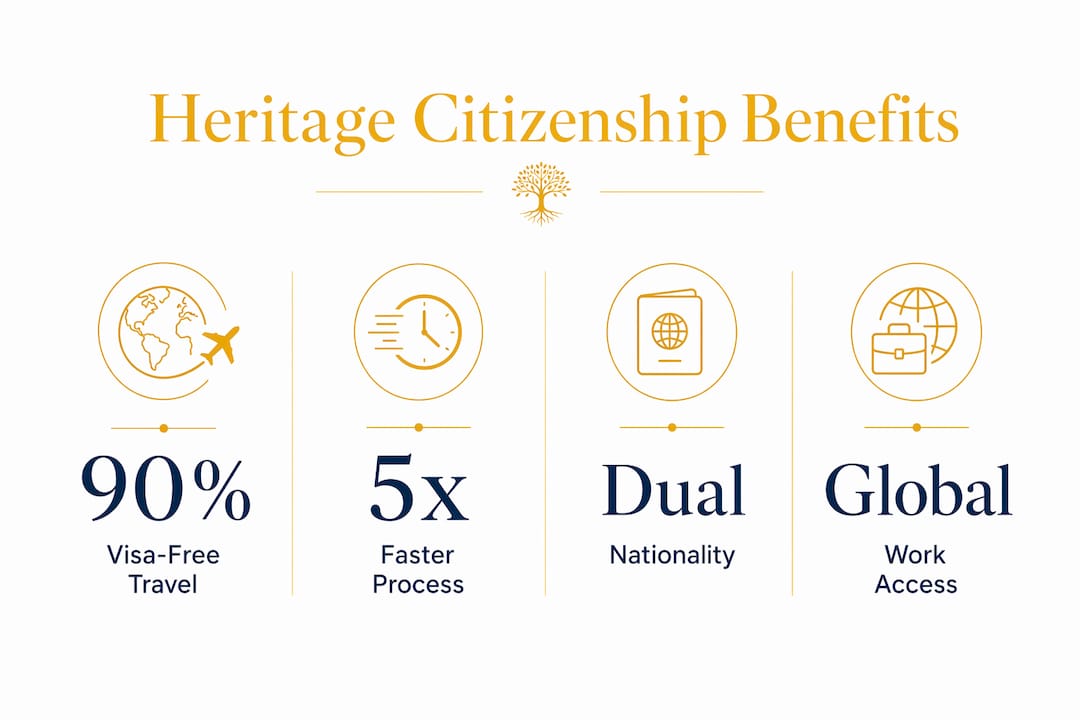
For families affected by migration or displacement, restoring heritage citizenship carries deep emotional weight. Genealogical research and citizenship restoration deepen family identity and create continuity across generations that oral history alone cannot provide. Many applicants describe the process as recovering something that was lost, not simply acquiring something new.
The cultural significance of heritage citizenship shows up in four concrete ways:
-
Identity continuity. Reclaiming citizenship connects you to a legal and cultural identity your ancestors held, giving that history formal recognition.
-
Intergenerational transfer. Once you hold citizenship by descent, your children may inherit it automatically, extending the benefit forward.
-
Resilience for migrant families. For communities displaced by war, political upheaval, or economic hardship, restoring citizenship serves as a resilience tool that reconnects families to their origins.
-
Cultural access. Citizenship opens doors to language programs, cultural institutions, and civic participation that residency permits do not.
“Citizenship as inherited civic capital encourages preservation of this legal status as a legacy resource for future generations, supporting access to rights and opportunities that span education, healthcare, and labor markets.”
Many Americans pursue ancestry citizenship not to emigrate permanently, but to hold both identities simultaneously. The emotional and practical benefits reinforce each other. You gain a legal right while also honoring your family’s history.
Which rights and global mobility benefits does heritage citizenship provide?
The practical benefits of heritage citizenship are substantial. An EU passport obtained through ancestry offers visa-free access to over 100 countries, and EU passports consistently rank among the most powerful travel documents in the world in 2026. That access alone changes your options for work, study, and retirement.
Travel and residency rights
Holding EU citizenship through descent gives you the right to live, work, study, and retire in any of the 27 EU member states. You do not need a work visa or a residency permit. You enter as a citizen, with the same rights as nationals of that country.
For non-EU heritage citizenship, the benefits vary by country but typically include:
-
Visa-free or visa-on-arrival travel to dozens of countries not accessible on a U.S. passport alone
-
The right to own property in the heritage country without foreign buyer restrictions
-
Access to public healthcare systems as a citizen rather than a paying visitor
-
Eligibility for subsidized or free university education in many European countries
-
The right to retire in the heritage country without an investor or retirement visa
Lifestyle and financial flexibility
Heritage citizenship gives you genuine options. You can work remotely from a European city without visa restrictions. You can send your children to a European university at domestic tuition rates. You can retire abroad without navigating complex long-stay visa programs. These are not hypothetical benefits. They are legal rights that activate the moment your citizenship is confirmed.
You can explore which countries offer descent-based pathways to understand where your family tree might open doors. The range is broader than most people expect, covering countries across Europe, Latin America, and beyond.
What are the eligibility criteria and common challenges?
Eligibility for citizenship by descent depends on one core requirement: an unbroken, document-supported lineage chain connecting you to a qualifying ancestor. The most common reason applications fail is a break in that chain due to missing civil records, not the number of generations between you and your ancestor.
What documents you need
Every link in your lineage chain requires official, government-issued documentation. That means birth certificates, marriage certificates, and death records for each generation between you and your qualifying ancestor. Documents must be properly legalized and, in most cases, officially translated. Oral history is insufficient as evidence in any ancestry citizenship claim, regardless of how detailed or credible it is.
Common eligibility challenges include:
-
Missing civil records from countries with incomplete historical archives or records destroyed in wartime
-
Name variations across documents due to transliteration, spelling changes at immigration, or clerical errors
-
Naturalization breaks where an ancestor naturalized in another country before the applicant’s parent was born, which can sever the legal chain in some jurisdictions
-
Incorrect lineage pathway where applicants apply through the wrong parent’s line, triggering rejection under historical legal frameworks
Choosing the correct legal pathway
Selecting the right legal basis for your claim is as important as gathering documents. Many early 20th-century citizenship laws were patrilineal only, meaning descent through the mother’s line was not recognized until later legal reforms. Applying through the wrong lineage pathway results in rejection, even when the documentation is complete.
Pro Tip: Before you gather a single document, confirm which lineage line qualifies under the specific country’s laws and which historical legal framework applies to your ancestor’s generation. A citizenship eligibility assessment can clarify this before you invest significant time and money.
A citizenship eligibility assessment maps your family tree against the specific legal requirements of your target country. It identifies gaps in your documentation and confirms which legal pathway applies. Skipping this step is the most expensive mistake applicants make.
How Roots Recovered, LLC can help you claim your heritage
Roots Recovered, LLC specializes in guiding individuals through the full citizenship by descent process, from initial eligibility review to final application submission.
The firm’s approach starts with a thorough assessment of your ancestry and the legal frameworks that apply to your family’s specific situation. Roots Recovered, LLC handles documentation guidance, consular correspondence, and application preparation, removing the guesswork from a process that has many moving parts. Their established connections with European consulates and a proven success rate make them a reliable partner for applicants at any stage. If you are ready to find out whether your ancestry qualifies, learn more about citizenship by descent and what the process involves. You can also review the full range of ancestry citizenship services Roots Recovered, LLC offers.
Key Takeaways
Heritage citizenship is the most efficient path to dual nationality for individuals with documented ancestry, delivering legal rights, global mobility, and cultural continuity without residency requirements.
| Point | Details |
|---|---|
| Efficiency over naturalization | Descent-based citizenship skips the 5–10 year residency and language testing required by standard naturalization. |
| Documentation is everything | An unbroken chain of legalized, translated civil records is the single most important factor in application success. |
| EU passport power | Ancestry-based EU citizenship grants visa-free access to over 100 countries and full residency rights across all 27 EU states. |
| Cultural and generational value | Citizenship by descent functions as inherited civic capital, transferable to your children and future generations. |
| Legal pathway selection matters | Applying through the wrong lineage line (maternal vs. paternal) causes rejection regardless of document quality. |
FAQ
What is heritage citizenship?
Heritage citizenship, formally called citizenship by descent or jus sanguinis, is the legal right to claim nationality through documented ancestral lineage rather than residency. It grants the same rights as any other citizen of that country.
How many generations back can I claim heritage citizenship?
The number of qualifying generations varies by country. Some nations allow claims through grandparents or great-grandparents, while others limit eligibility to one generation. The key factor is an unbroken, documented lineage chain, not the number of generations.
What documents do I need for a heritage citizenship application?
You need official, government-issued birth, marriage, and death certificates for every generation between you and your qualifying ancestor. All documents must be properly legalized and officially translated. Oral history or family records are not accepted as legal evidence.
Can I pass heritage citizenship to my children?
Yes. Once you obtain citizenship by descent, your children may inherit it automatically depending on the country’s laws. This makes heritage citizenship a long-term asset for your entire family line.
Why do heritage citizenship applications get rejected?
The most common cause of rejection is a break in the documented lineage chain due to missing civil records. Choosing the wrong legal pathway, such as applying through a lineage line not recognized under historical law, is the second most frequent reason for failure.