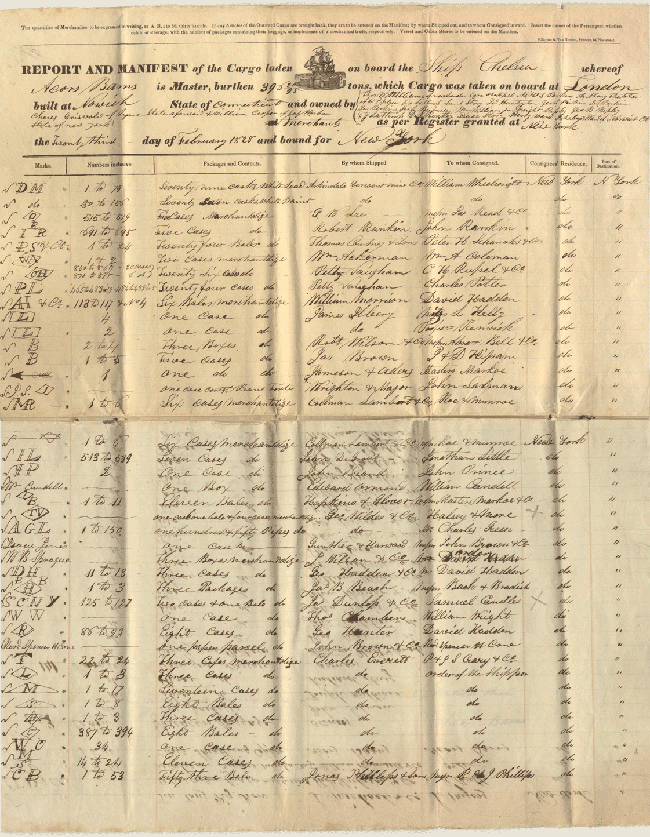
Most U.S. ship passenger manifests covering arrivals from about 1820 through December 1982 are held or indexed by the National Archives (NARA). Records touching people who were still alive after May 1, 1951 may also live in a USCIS Alien File (A-File), and arrivals after December 1982 sit primarily with USCIS. If you’re building a case for citizenship by descent, here’s where to start today:
- Search NARA’s Access to Archival Databases (AAD) and the Manifest Header Records.
- If the arrival happened after 1957, or after 1982, prepare a USCIS FOIA / A-File request.
- Keep Form NATF 81 on hand for ordering directly from NARA.
Roots Recovered, LLC helps clients turn these scattered records into evidence a consulate will accept.
Key Takeaways
Locating a U.S. ship manifest depends on matching the arrival date to the correct custodian, NARA for 1820 through 1982, USCIS for A-Files and later arrivals, and linking the passenger entry to its manifest header for ship-level details.
| Point | Details |
|---|---|
| Know the date cutoff | NARA holds records from about 1820 to December 1982; USCIS handles A-Files and later arrivals. |
| Get the manifest ID | Passenger entries rarely include ship data alone; the header record supplies the arrival date and vessel name. |
| Verify before you trust it | Compare any transcription against the original image or microfilm to catch spelling and indexing errors. |
| Prepare before you request | NATF 81 orders and USCIS FOIA requests both move faster with an exact date, port, and vessel name. |
| Get professional help for complex cases | Roots Recovered, LLC handles A-File requests, certified copy procurement, and eligibility assessment together for citizenship-by-descent applicants. |
Table of Contents
- What Do Ship Manifest Records Actually Contain?
- Where Are Vessel Cargo Records and Passenger Lists Actually Kept?
- How Do You Search and Link a Manifest Record?
- How Do You Order Copies From NARA or File a USCIS FOIA Request?
- How Do You Verify a Manifest Entry Is Accurate?
- When Should You Bring in Professional Help?
- Frequently Asked Questions
- Sources
What Do Ship Manifest Records Actually Contain?
A passenger manifest is a snapshot, not a biography. Most entries list the passenger’s name, age, nationality or place of birth, ship name, arrival date, last place of residence, occupation, and a physical description covering height, eye color, and hair color. Later manifests often add how much money the passenger carried and the name and address of a relative waiting at the destination.
What you won’t find is anything resembling a full civil record. Manifests rarely include a birth certificate number, a detailed family history, or legal documentation of citizenship. They’re also a completely different animal from cargo manifest documents, which record freight, weight, and customs classifications rather than people. Coast Guard rules even require certain cargo record books to be retained onboard for years for regulatory reasons that have nothing to do with genealogy.
- Common fields: name, age, birthplace, ship name, arrival date, last residence, occupation, physical description.
- Rare or absent: birth certificates, detailed biography, legal citizenship status.
- Never confuse: passenger manifests with cargo manifests or air cargo forms.
Pro Tip: Always pull the original image or microfilm frame instead of relying solely on a transcription. Names get misspelled, columns get skipped, and handwriting gets misread constantly. A transcription is a lead, not proof.
Where Are Vessel Cargo Records and Passenger Lists Actually Kept?
Custody depends almost entirely on the arrival date, and getting this wrong wastes weeks. NARA holds the bulk of passenger arrival records from roughly 1820 through December 1982, though gaps exist, particularly for the earliest years and for some smaller ports. Anyone whose ancestor arrived before 1820 won’t find federal manifests at all, since the requirement to file passenger lists only began that year, which means state or port-level sources become the fallback.
For anyone documented after May 1, 1951, an Alien File (A-File) may exist through USCIS, and it can contain far more than the original manifest, including naturalization steps and later immigration proceedings. Arrivals after December 1982 are primarily USCIS territory, and FOIA requests for that era demand real precision.
A search that lacks the exact arrival date, port, and vessel name for post-1957 records is often unsuccessful, according to NARA’s own guidance on immigration record custody. That single detail trips up more researchers than any other step in the process.
The main places to actually search:
- NARA’s Access to Archival Databases (AAD) and the Manifest Header Records for federal-era arrivals, free to search.
- Statue of Liberty–Ellis Island Foundation database, strong specifically for New York arrivals through 1957.
- FamilySearch.org, free, with growing digitized image collections.
- Ancestry.com, subscription-based, with broad indexing and original images for many collections.
- USCIS FOIA portal, the only route to A-Files and post-1982 records.
Two traps catch people repeatedly. First, federal airport arrival and departure records simply are not maintained the same way after 1970, so an ancestor who flew in rather than sailed will leave a much thinner paper trail. Second, commercial databases inherit transcription errors from the original indexing work, so a name that looks wrong might just be a bad transcription rather than a bad record.
How Do You Search and Link a Manifest Record?
Finding a name is only half the job. You then have to connect that passenger entry to the manifest itself, which is where the ship name, arrival date, and port actually live. Here’s the sequence that works:
- Start with what you know. Write down every plausible spelling of the name, an approximate birth year, and a likely arrival window.
- Search the passenger record sets in AAD, FamilySearch, or Ancestry using those variants.
- Capture the manifest identification number attached to the passenger entry you find.
- Search the Manifest Header Records using that identification number to pull the ship name and exact arrival date.
- Cross-check the microfilm roll, if needed, using a guide like the T715 series for New York arrivals from 1897 to 1957, which lists roll numbers by date range.
This two-step search exists because passenger-level entries rarely carry full ship data on their own; the header record is where arrival date and vessel name actually sit. Skip that step and you’ll have a name with no context.
A quick example: say you find “Giuseppe Bianchi” indexed as “Joseph Bianco” in a passenger file. You note the manifest ID attached to that entry, plug it into the Manifest Header Records, and it returns a ship name and an arrival date in 1912. Now you have enough to request the original image or microfilm frame.
When a manifest ID returns nothing:
- Try a different passenger-file collection or database entirely.
- Broaden the name search to phonetic variants or partial matches.
- Recheck the assumed arrival year. Family stories are often off by a year or two.
How Do You Order Copies From NARA or File a USCIS FOIA Request?
For arrivals roughly between 1820 and 1959, use Form NATF 81 or NARA’s online ordering system to request certified copies. Have the passenger’s name, approximate arrival date, port, and ship name ready before you submit; vague requests take longer and sometimes come back empty.
For anyone documented after May 1, 1951, or arriving after 1982, you’re filing with USCIS FOIA instead. These requests are unforgiving. Missing the exact arrival date, port, or vessel name is the single most common reason a FOIA search for later records comes back unsuccessful.
Before you submit anything, confirm you have:
- Full legal name and known alternate spellings.
- Approximate or exact arrival date.
- Port of arrival and, if known, the vessel name.
- Any known A-File number, if a prior immigration proceeding exists.
Expect NARA requests to take weeks rather than days, and USCIS FOIA requests can take considerably longer depending on backlog. Neither agency offers a reliable expedited path for genealogy requests, so building in lead time before a consulate deadline matters.
How Do You Verify a Manifest Entry Is Accurate?
A manifest is only useful if you can trust it, and trusting it means checking it against something else. Start by comparing any transcription to the actual image or microfilm frame. Then pull the manifest header to confirm the ship name and arrival date match what the passenger record claims.

From there, corroborate. Census records, naturalization papers, and even old city directories can confirm or contradict a manifest’s details. If a manifest lists a relative’s name and address at the destination, that’s often the fastest way to confirm you’ve found the right family, not just a similar name.
A few traps show up again and again. Names get Anglicized or phonetically respelled between the original language and the immigration clerk’s handwriting. Place names change, especially for regions that shifted between countries after border changes in the 20th century. And occasionally someone confuses a passenger manifest with a cargo document. Cargo manifests are administrative commercial paperwork for customs and revenue, and they contain no passenger biographical data at all.
- Compare transcription against the original image or microfilm.
- Confirm ship name and date against the Manifest Header Record.
- Cross-reference with census and naturalization records.
- Watch for archaic place names and inconsistent spelling.
Pro Tip: If a consulate requires certified copies for a citizenship-by-descent application, request them directly from NARA rather than printing a screenshot from a commercial database. Consulates generally want an official reproduction, not an index entry.
When Should You Bring in Professional Help?
Some manifest searches take an afternoon. Others take months, especially when a name has three spelling variants, the arrival record sits in a post-1957 A-File, or a consulate deadline is closing in fast. That’s the point where Roots Recovered, LLC becomes the faster path instead of a do-it-yourself archive hunt: our team runs the eligibility assessment, the archival research, the FOIA and A-File requests, and the certified copy procurement together, rather than leaving you to coordinate separate agencies on separate timelines.
We’re a practical alternative to spending weekends cross-referencing microfilm rolls on your own. If your ancestor’s manifest is tangled up in name variants, missing years, or a FOIA request that needs airtight precision to succeed, that’s exactly the kind of case we handle daily.
Before reaching out, gather what you already have: known name spellings, approximate arrival dates, any manifest identification numbers, and ship names if you’ve found them. That prep work alone can cut weeks off the process. Start with our citizenship eligibility assessment to see what your documentation already supports and where the gaps are.
Frequently Asked Questions
What date range do ship manifest records typically cover?
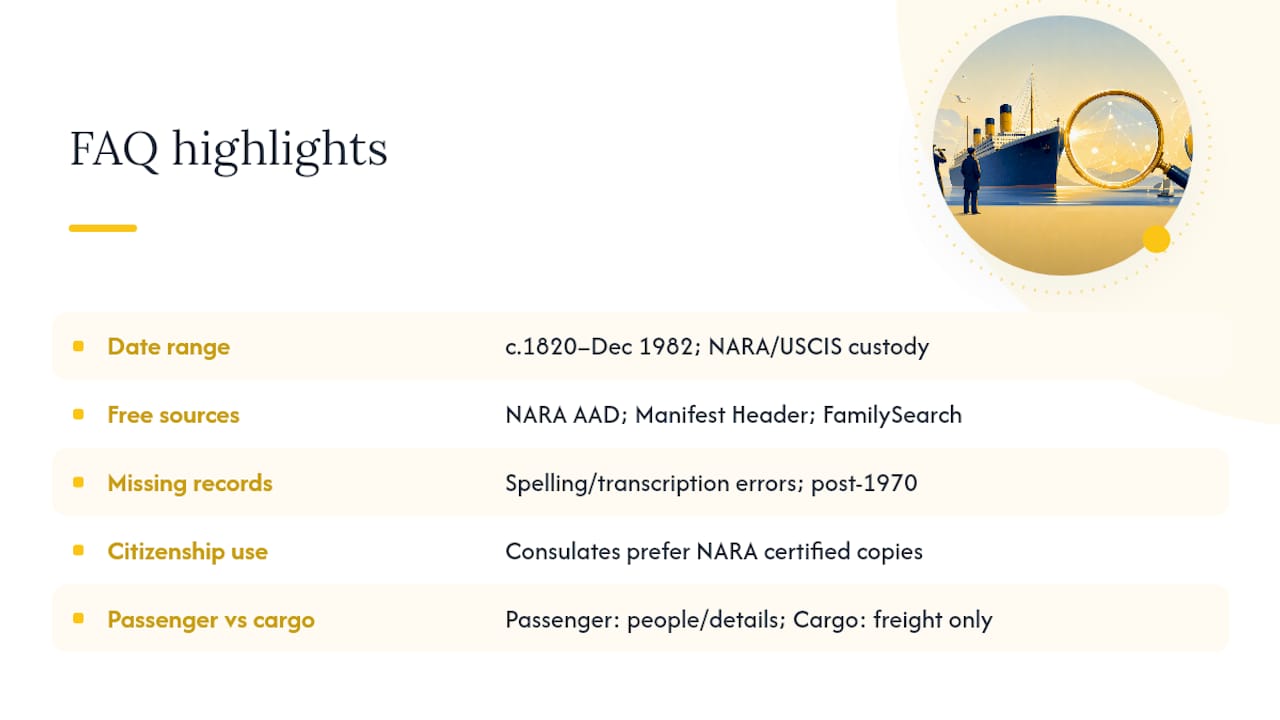
U.S. passenger arrival records generally run from about 1820 through December 1982, with custody split between NARA for that era and USCIS for A-Files and later arrivals.
Can I find a manifest record for free?
Yes. NARA’s AAD, the Manifest Header Records, and FamilySearch.org are free to search, though original certified copies may carry a fee when ordered through NARA.
Why can’t I find my ancestor’s manifest even though I know the year they arrived?
Name spelling variants, transcription errors, and airport arrivals after 1970 (which aren’t maintained the same way as maritime records) are the most common reasons. Try alternate spellings and confirm you’re searching the correct passenger-file collection.
Do I need the original manifest image for a citizenship-by-descent application?
Consulates typically prefer certified copies from NARA over screenshots from commercial databases, so it’s worth ordering the official reproduction once you’ve confirmed the record.
What’s the difference between a passenger manifest and a cargo manifest?
A passenger manifest lists people and their biographical details. A cargo manifest is a commercial customs document listing freight, and it contains no information about passengers at all.